I pull up at this nice ass house, I’m walking to the door as the woman pulls in her driveway so the pizza is definitely not late.
I’m all smiley and courteous and shit, she tipped me $1 on a $51 bill.
The next house I have is in a lower class neighborhood, she tips me $4.00 on a $14 bill.
rich people don’t value yr labor at all
This has ALWAYS been my experience in food service. Rich people tip like shit because they feel your job isn’t a ‘real’ job. They’re used to being serviced so they don’t appreciate hard labor. It’s so gross.
And poorer people always tip nice because…well the opposite reason.
And the thing is we know servers rely on tips but so do delivery drivers. Because the US is a capitalist dystopia, there are companies that force drivers to pay for their fuel out of pocket, and I’ve known people who lost money working as delivery drivers because of this.
Also this is a more abstract form of wage loss, but they have to use their own vehicles, so the job hastens the need for oil changes, brake changes, and other expensive mechanic services.
“Capitalism is oppressive because I only get 3-4 hours of free time a day”
Ok, here’s a thought, and bear with me here: increase your value on the market place so you earn more $/hr so you can choose to work less hours.
And don’t tell me you can’t do that because you can learn practically anything online for free or from library books.
A primer on poverty, free time, and choosing to earn more money.
1. The United States is second only to Nicaragua in blaming poor people for their poverty. So, congratulations you libertarian you! You’re expressing the call of the fucking herd, participating in a dumb chorus, and are not representing the light of social, practical, intellectual difference. Fully one quarter of your herd feel poor people are responsible for the own poverty in spite of the overwhelming facts pointing out the opposite. (x, y) One of the reasons for such an exaggerated fiction is that US and UK people work some of the longest and strangest hours in the world. That’s all of us, not just the poor. (x) Our fictions are bound to be more exaggerated.
2. Owners and bosses make so much more money than the average employee that the exaggeration of unearned ambition (see Adam Smith, Part I, Chapter II, here) that’s been a problem in capitalism since its inception is much more exaggerated and problematic today. It’s understandable why you want to imply poor people don’t want to work, although the opposite is the solid truth. Capitalist society values work more than equality, and so even the poorest and unhappiest people are willing to work long and strange hours. We have to address how the division of labor works to promote a sense of fairness about income inequality.
3. We use vague words like inequality to address fairness. Fact is, we can address value very specifically. Workers don’t earn anything approaching appropriate compensation for the hours they work, while owners and employers are earning much more than they’re actually worth, in spite of working similar hours. (x, y) The fact is that, for some reason, we permit some people to say they are worth more than others. Likely, this is a result of the form cooperation between employee and employer takes in capitalism, where employees sacrifice earnings for a number of promises, such as safety at work, access to forms of insurance, compensation for injury, and provided tools and resources. I know from experience that Americans believe bosses pay out of pocket for these “materials”, but the truth is labor produces them. Without labor, we’d have zero wealth creation. That’s a fact. It makes sense to complain. If we’re not going to be compensated more fairly, then we should get more time away from work.
4. I’ve addressed in another post how talking about “wealth” instead of “value” helps generate momentum for the fiction that the long hours rich employers work and the amount of wealth capitalists possess prove they’ve earned their status and wealth. It’s not true. It never has been true. Simple analysis will illustrate that. Just look at the data gathered about work. It’s easily accessible these days. On the other hand, one needs analysis plus social engineering to be able to argue wealthy people have earned their wealth while poor people haven’t earned it yet. Your hero von Mises had to compose a social theory of human action that insists it’s best to think of people as consumers and business owners rather then employee and employer for just this reason. It’s easy to talk about choices, freedom, and liberty when we’re addressing bosses and consumers and wildly wealthy elites. To be antisocialist in a capitalist society insists one must agree about a few conditions before making any arguments about social equality and identity. The theory comes not from metaphysics but from social engineering; in other words, it’s propaganda.
5. But facts are facts. In 2012, for example, the majority of able-bodied poor worked. (x) Year in and year out, the poor work. And they work hard–multiple jobs, night and day, with little sleep. Look we all know that money earned is worth more to the poor than the rich; another way to put it, poverty is expensive. Spending to sustain healthy life takes all of our money. Wealthy people can afford to spend money on investments and entertainment. They tend to lead happier lives for obvious reasons. (x) The link shows that the wealthiest people in the US receive much more of their income from wages than the poorest people do.
6. Something in the assumed rationale in your claim above tells me you think that people earn more money because they have some skills associated with their social status and pay that poorer people lack. That’s simply not the case. We know that a college degree, for example, is worth less if the student and future employee is born poor and worth more if born wealthy. (x)
We can say, without a doubt, that spending what little leisure time we have away from work “bettering” (part of the capitalist myth about social mobility is that we can choose to become better) ourselves is not necessarily going to do anything to increase our value in the workplace.
7. I’m going to give you a little wake up call for your notion that people can choose to become more wealthy. It’s certainly true in the past that much of the wealth in the US was earned rather than inherited. And this only makes sense because much of the wealth (money and value) has been only recently created via economic booms (and recoveries from busts). There wasn’t massive accumulations of wealth to bequeath in the recent past. (Caveat: for a very small, minority of Americans there always has been great wealth and that was inherited. We’re not addressing them.)
We know wealth is an accumulation of excess income over expenditures over time. Wealth inequality is on the rise, all over the world. Thus, we know that these days, and even more so in the days to come, as wealth inequality rises, more people will begin inheriting wealth rather than earning it.
Choosing to be better becomes even more of a fantastic myth.
8. Finally, it’s an intellectual cop out to claim people can educate themselves for free. I’ve been teaching for close to twenty years. Much of the education that future employees exchange for better wages involves learning achieved from within institutions that engage different learning communities and wherein people can make various valuable social connections that permit them referrals, aid, cooperation, and affiliation, all of which costs a lot of money.
What 16 trillion dollar debt? I have no idea how my free stuff is going to appear. I just know I want it.
He’s raising taxes on the rich
He’s planning on stealing more from people… ok that makes sense. Just because *They* are rich doesn’t mean those people deserve to have more of their wealth stolen from them.
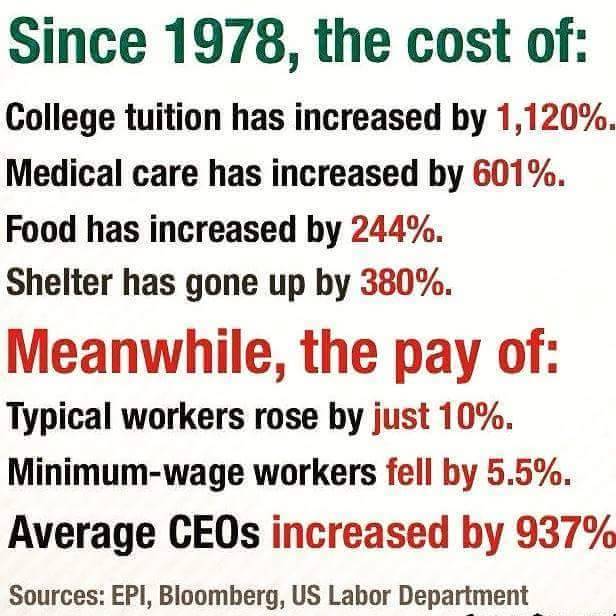
Yes because the wealthy billionaires that steal and undervalue labor, and companies that scapegoat paying taxes are really hurting
why even bring up the national debt if you don’t want people to pay taxes
I’m on the phone half asleep, but yeah, Thank you for real
I don’t think OP understands what rich people are. Like they literally won’t even notice the taxes. It will make no impact on the wealthy at all. You could take literally 50% of the income of the top 10% and they would have to make zero changes to their lifestyle.
Money to them is just a high score. They whinge when you take them down a bit but it makes literally no difference because they’re still winning the fucking game.
They do actually 100% deserve to have their money taken. People are starving to death because we think disability payments shouldn’t be enough to live on and minimum wage should be half of what you need to survive so yeah, I think millionaires and billionaires deserve to have a tiny fucking fraction of the money they could never spend in a fucking lifetime so I can fucking EAT AT ALL.
I also don’t think people understand actually how much a billion dollars is. Like. it’s such an enormous number.
We think of numbers that big like a set of stairs, a hundred, a thousand, ten thousand, a hundred thousand, a million, ten million, a hundred million, a billion.
With each jump just being another step on the staircase and not realising HOW FUCKING HUGE each step is, and how vast the gap is between each of them.
Aside from the fact that even a million dollars is far more than you need, a billion is disgusting excess. There is no conceivable way one person could justify needing a billion dollars when you know HOW MUCH that is.
To put it in perspective: a million seconds is 11 and a half days a billion seconds is 31 years and 9 months.
Another example would be Warren Buffett: He made $US12.7 billion in 2013. That was his yearly income, not his total worth. Just his income for 2013.
That’s $37 million per day; $1.54 million per hour; $25,694 per minute
How much do you get per hour? Is it enough to live on? the minimum wage in america is $15,080per year That man makes more money per minute just for being alive, even in his sleep than most of you do in an entire year.
also, just using seconds for reference again
15,080 seconds is just over 4 hours. 12.7 billion seconds is 402 years and 4 months.
Ok so I tried and the number differences broke the weird little graphing thing I was using.
so here we have one thousand (1,000) not showing one million (1,000,000) at one pixel
and one billlion (100,000,000) is the big pilon there.
I added fifty million in to show because that graph goes in increments of 50 million.
So how much is 50 million compared to a million though, it’s only one pixel?
so smol. But still we’re trying to get down to a thousand, (which is ten hundred-dollar-bills.)
So what does a million look like compared to a thousand?
oh. We broke it again. It will only go in 50 thousands. So we got to look at how big 50k is compared to our wad of hunjies.
ok.
This is why i like using the seconds instead of graphs… But I won’t give up here.
the reason it’s so so hard to process is because a BILLION is an enormous number. there comes a point with numbers where we can’t actually process them and its just like…a lot. And more than “a lot” is still “a lot”.
So we need visual representation. Lets use pennies (thanks megapenny)
Imagine a penny. Just one.
Ok, you get a thousand pennies a week, and you end up with 52 thousand in a year. If they were dollars that’s a nice paying wage.
with me?
now this is a thousand pennies.
this is 50 thousand pennies (1 square foot solid of pennies! COOOOL) It’s roughly how many pennies you would have in a year if you got a thousand pennies a week.
This is a million pennies
And this is a billion pennies
(Which is 5 schoolbuss sized blocks of solid pennies.)
that is so many.
.
The problem with numbers is that we see them written like this
1 100 1000 1000000 1000000000
And we kind of subconciously go “well… it’s only increasing a little at a time, like a staircase. When the progression is more like
And so on. which is not a staircase I want to climb because it starts off reasonable and then jumps to building size, then mountain size.
We ‘add a zero’ which is confusing because it’s timesing (x) not adding (+).
to make ten thousand dots, I would copy all the dots in my thousand pile, and paste them ten times. to make a hundred thousand, I would copy all the dots in my ten-thousand-dot pile and paste them ten times. thats what “times by ten” means.
That’s what adding a zero is, it’s multiplying (x) the last number we had by ten. (i also say timesing: as in copy and pasting it ten times) try it with a word document and see how many pages it takes to get you a billion dots, and how many it takes for 15 thousand (minimum wage anual)
hopefully this was at least somewhat useful.
Anyway, the point is that if we imagine them as dollar coins, and one square block is established as good enough to live by a year, there’s no reason one individual deserves 5 bus-worths.
I literally was about to google a visual representation of this and then THERE IT WAS IN THE POST
Seriously. It’s time for people to wake the fuck up. I’m sick of the godsdamned wilful blindness.
We had this conversation in my sociology class.
If you dont understand the wealth distribution in america, here you go
This is what OP and America thinks it is
What it actually is. Evaluate your life. Evaluate your income. This is why we need to take from the 1%
The 1% makes so much money its off the grid.
If you stack the 1% money next to eachother it would be like this
That 0% is your college students and people working fast food. Its below the poverty line. So taxing the 1% wont do shit to him.
This post got so incredibly awesome I’m almost glad OP posted it in the first place-almost
the graphs stappls posted is exactly what my econ instructor shared with my class three years ago. that graph is what made me even MORE pissed off about income distribution. icing and sprinkles on the god damn cake.














 Waiting for Winter