Circus Tree: Six individual sycamore trees were shaped, bent, and braided to form this.
Actually pretty easy. Trees don’t reject tissue from other trees in the same family. You bend the tree to another tree when it is a sapling, scrape off the bark on both trees where they touch, add some damp sphagnum moss around them to keep everything slightly moist and bind them together. Then wait a few years- The trees will have grown together.
You can use a similar technique to graft a lemon branch or a lime branch or even both- onto an orange tree and have one tree that has all three fruits.
Frankentrees.
As a biologist I can clearly state that plants are fucking weird and you should probably be slightly afraid of them.
On that note! At the university (UBC) located in town, the Agriculture students were told by their teacher that a tree flipped upside down would die. So they took an excavator and flipped the tree upside down. And it’s still growing. But the branches are now the roots, and the roots are now these super gnarly looking branches. Be afraid.
But Vi, how can you mention that and NOT post a picture? D:
I am both amazed and horrified of nature as we all should be
It’s actually extremely common for an apple tree to be two halves of different kinds of apple trees. Some apple trees make good fruit, others have strong roots. So you grow an apple tree with good roots, cut the top off, and graft a piece of fruity apple tree to it.
Have you considered that those scientists might be bias and pushing an agenda. Gender is a biological absolute.
Gender is highly contextualized by time and place. Like, if you want to talk about scientists being biased and pushing an agenda, look at modern western science for pushing a flawed binary narrative.
Non-binary genders are not a modern invention. The idea of third genders/non-binary genders is as old as human civilization, because gender is socially constructed and subjective, and people’s ideas about gender have changed over time and between cultures.
In Mesopotamian mythology, among the earliest written records of humanity, there are references to types of people who are not men and not women. In a Sumerian creation myth found on a stone tablet from the second millennium BC, the goddess Ninmah fashions a being “with no male organ and no female organ”, for whom Enki finds a position in society: “to stand before the king”.
In Babylonia, Sumer and Assyria, certain types of individuals who performed religious duties in the service of Inanna/Ishtar have been described as a third gender.
Inscribed pottery shards from the Middle Kingdom of Egypt (2000–1800 BCE), found near ancient Thebes (now Luxor, Egypt), list three human genders: tai (male), sḫt (“sekhet”) and hmt (female).
The Vedas (c. 1500 BC–500 BC) describe individuals as belonging to one of three categories, according to one’s nature or prakrti. These are also spelled out in the Kama Sutra (c. 4th century AD) and elsewhere as pums-prakrti (male-nature), stri-prakrti (female-nature), and tritiya-prakrti (third-nature).
Many have interpreted the “eunuchs” of the Ancient Eastern Mediterranean world as a third gender that inhabited a liminal space between women and men, understood in their societies as somehow neither or both. In the Historia Augusta, the eunuch body is described as a tertium genus hominum (a third human gender),
The ancient Maya civilization may have recognised a third gender, according to historian Matthew Looper. Looper notes the androgynous Maize Deity and masculine Moon goddess of Maya mythology, and iconography and inscriptions where rulers embody or impersonate these deities. He suggests that the third gender could also include two-spirit individuals with special roles such as healers or diviners
Anthropologist Rosemary Joyce agrees, writing that “gender was a fluid potential, not a fixed category, before the Spaniards came to Mesoamerica. Childhood training and ritual shaped, but did not set, adult gender, which could encompass third genders and alternative sexualities as well as “male” and “female.” At the height of the Classic period, Maya rulers presented themselves as embodying the entire range of gender possibilities, from male through female, by wearing blended costumes and playing male and female roles in state ceremonies.“
Andean Studies scholar Michael Horswell writes that third-gendered ritual attendants to chuqui chinchay, a jaguar deity in Incan mythology, were “vital actors in Andean ceremonies” prior to Spanish colonisation.
Two-spirit individuals are viewed in some Native American cultures as having two identities occupying one body. Their dress is usually a mixture of traditionally male and traditionally female articles, or they may dress as a man one day, and a woman on another.
In Pakistan, the hijras are officially recognized as third gender by the government,
Well that’s stupid. All this proves is that special snowflakes are older then we thought.
Wait, did someone argue myth when discussing science? Really? There isn’t a third gender, there are genetic mutations and abnormalities. There are genetic flukes that are usually sterile because they are mess ups and their genetics were never meant to continue.
What my examples show if that GENDER has been conceptualized as something separate from biological sex for THOUSANDS of years. The idea that gender is a self identification that does not always align with expectations based on sex is not new and it is not isolated. THAT is what my examples are demonstrating.
And not all people with atypical chromosomal and genital genotypes and phenotypes are sterile. And their existence should point us toward the fact that sex is a complicated interaction between SEVERAL FACTORS, with some combinations more common than others- not a neat set binary.
Watching people try to claim that gender = sex, and further that sex = binary, and then flailing their arms like Muppets when they’re given, you know, tons of sources going back thousands of years, is always awkward.
You’d think at some point they might examine the idea that the people shouting “there’s only ever been a binary” might have an agenda, but … no such luck.
And here, esteemed audience, can we see the goalpost mover in their natural habitat. As you can see they are utterly immune to citations and scientific proof, a fascinating ability found mainly in niche dwellers like the male rights bawler and the common racist. Careful now, we’ll try to get a closer look –
The average active adult needs 2,000 calories per day in order to function in a safe and healthy manner. If I’m active to the point where I consistently run 1+ hour every day, then it is far more likely that my caloric needs are around 2,400-2,500.
Considering that, a meal of 1,200 calories would perfectly suit my needs. It would supply roughly half of my calorie requirements, which is a God-send since a fast food meal is relatively cheap. It’s a great value, especially if I don’t have much time to cook or have the resources to prepare my own meals!
The average burger is going to supply me with significant protein and carbs. That’s exactly what I’d need in order to build more muscle and have enough energy to make it through a workout. Even the sugar within the meal can be beneficial in supplying me with a boost of energy and can stop me from feeling hungry for a prolonged period of time. Not half bad.
Is this the most healthy meal known to man? Of course not. But it’s still a very reasonable deal and the calorie count is well within the average adult’s daily needs.
Don’t let calories scare you! You need them. If you were capable of burning off an entire meal within the hour, you’d probably be dead by now.
1200 empty calories in a meal
next to no nutrition. all the calories are sugar and fat. that’s it. you’ll have no energy and have glucose spikes in your blood because the lack of fiber because of the lack of complex carbs. this is diabetes in a meal.
so no, you should not be hungry for diabetes
Nutritionally, this BK meal contains roughly 28g of protein and 3g of dietary fiber. It potentiallyalso includes 35% of our Vitamin C daily requirements, 2% Vitamin A, 12% calcium, and 27% iron. Of the 1,010 calories (that I could verify directly from the company’s nutritional information guide), only 410 are from fat. That isn’t a terribly significant amount of fat, in the long run, nor are the nutrients small enough to be viewed as negligible.
Eating this will not cause you to get diabetes. Eating this meal is perfectly fine if you do have diabetes, as long as you are able to adjust your insulin intake accordingly. So don’t use an illness as your debate point – Diabetic people are not a prop.
“So don’t use an illness as your debate point – Diabetic people are not a prop.” I want that and variations of that on t shirts.
damn, man. Someone just got completely schooled by a nutritionist.
Lay your arm on a flat surface and push
your thumb and pinky together. If you
don’t see a raised band across your
wrist, you are a product of evolution.
If you do, you’ve got a useless extra
muscle in your arm that is slowly being
erased from our genetic code. Source
I just did some research on this and apparently this muscle actually helps you hold a spear (something we as a majority haven’t needed to do much of in recent times, thus it is a mutation that is neither harmful nor helpful to lack this muscle) But I’ll see you all in the post-apocalyptic world with my genetic advantage to hold and throw spears~
Looks like you’re going to have to do all the spear throwing for me.
tag yourself im a spearholder
*walks up to couple*
so which of you is evolved and which is the spearholder
spearholder, both me and my SO.
XD
Is anybody… is… is anybody gonna… No? Okay. I’ll do it then.
Okay, see, this is like 94% bullshit. I mean, it’s about 6% science, yes, but it’s also 94% bullshit.
First things first, “you are a product of evolution”. What. Every organic thing on the face of the planet is a product of evolution. Evolution kicked off somewhere around 3.8 billion years ago with the first appearance of life and it hasn’t really stopped since. Everything that came before you was “a product of evolution”. That phrase doesn’t mean anything special.
But Bear, you say, it means people without the thing are just more highly evolved than those who have it!
Bullshit, I say. There is no such thing as “more highly evolved.” Evolution is not some kind of mad rat-race to see which lineage makes it to the top of Darwin Mountain first. Evolution is about creating an organism that can survive and reproduce as effectively as possible to fill a particular niche or role in its given ecosystem.
How good are you at burrowing in the dirt and eating leaf litter? You probably suck at it. But roly-polies (aka, sowbugs, pillbugs, or terrestrial isopods) are great at this! Is a roly-poly less evolved than you because it doesn’t drive a car and use the internet… or are you less evolved than a roly-poly because you can’t break down leaf litter into small, usable particles? The answer is neither–you’re both beautifully evolved organisms filling different niches in the ecosystem and doing it very well.
Now, so far as this “muscle” (it’s actually a tendon) being “slowly erased from our genetic code”… no.
Let me start out by saying something that really should have been said in the first place, because it’s a cool bit of knowledge to have and it’s fun to say: The tendon shown in the picture is called the palmaris longus. Palmaris longus! Say it out loud!
The palmaris longus is what is known as a vestigial tendon. When something is vestigial, that means that it’s no longer needed by the organism, but isn’t doing enough harm by being there that it impacts the organism’s ability to fill its niche and reproduce. A vestigial organ or body part neither helps nor hinders the organism; it’s just kinda there, a relic of eons past.
(For example, the tail of a bear. A tail is utterly useless to a bear–it is too short to provide any kind of stability while in motion, isn’t prehensile, and doesn’t play a role in body language–but they still have ‘em.)
Now, it’s true that vestigial traits have a tendency to disappear over time, but not because they’re being erased from the genetic code.
Evolution–hell, natural selection–depends on there being inherent variation among the population. If one individual has a variation that gives it an advantage, and said variation is genetically determined, there’s a slight chance their offspring will inherit that useful variation. Slight. Conversely, if one individual’s variation is a disadvantage, it may hinder its chances of reproducing, and thus prevent it from passing that unhelpful trait to the next generation.
But a vestigial trait, which confers no advantage or disadvantage, is sort of stuck in limbo and is only passed along by pure chance.
I’ve heard people say, for example, that wisdom teeth are “evolving out” of the human species, and it makes me want to throw mine–which were surgically removed when I was 18–at their faces. That’s not how evolution works. In order for a trait to “evolve out” of a species, it has to be selected against. It has to be obvious so that other members of the species can notice it and find it unsexy enough that they won’t mate with the individual displaying it.
Do you only date people who never developed wisdom teeth, in the hopes that any offspring you have with them will also never develop wisdom teeth? I’m thinking not. There’s no active selection against the wisdom tooth trait. If anything, there’s selection for the more refined, narrow jaw structure that separates our skulls from those of like every other ape on the planet (which coincidentally is why most people don’t have space in their jaws for a third set of molars to properly develop and erupt, and need their–frequently deformed–wisdom teeth extracted), and that may in turn be linked to whether or not wisdom teeth form.
Wisdom teeth, like the palmaris longus, are a vestigial trait that is being passed along purely by chance.
Oh but Bear! you say. The spear-holder argument! Our ancient cavemen ancestors who had this palmaris longus tendon could better grip and throw their spears. Wouldn’t being a better hunter make them a more desirable mate for cavewomen?
No. No it wouldn’t. And let me tell you why.
The palmaris longus is a vestigial tendon, has been for eons, and hasn’t conferred an evolutionary advantage on those who have it since we lived in trees.
Yeah. A well-developed (aka, not vestigial) palmaris longus tendon is really only found in arboreal animals, like monkeys. Found there, it does give an advantage by augmenting grip strength, and thus making those tree-dwelling monkeys a little less likely to fall out of the tree. But among humans, who are terrestrial apes? The palmaris longus is not needed and is nothing but a relic. It’s been a relic since, like, Australopithecus.
Studies show that there is no difference in grip strength between those who have the palmaris longus and those who do not. Which should surprise no one because, again, the tendon is vestigial.
Now, to make up for me crushing your hopes of being a better spear-holder, let me share with you some great facts about the palmaris longus tendon!
It’s found in roughly a quarter of the population.
It has a ridiculous amount of variety in how it presents. In some people, it’s just a tendon running from A to B along the forearm with no associated muscle. In others, the muscle (which is also poorly-developed and vestigial) is found in the middle of the tendon. In others, the muscle is at one end of the tendon. Also, in some people, it’s only present in one arm and not the other–so if you see it in one wrist, check if it’s on the other side as well. I have it on both arms.
Because it’s vestigial and is not “needed”, it is the number one choice for use in reconstructive work. Surgeons will use it to repair or replace tendons just about anywhere in the body, because they can remove it without any ill effect!
This has been your daily dose of science. Bear, out.
omg this explains it so much more and better than me
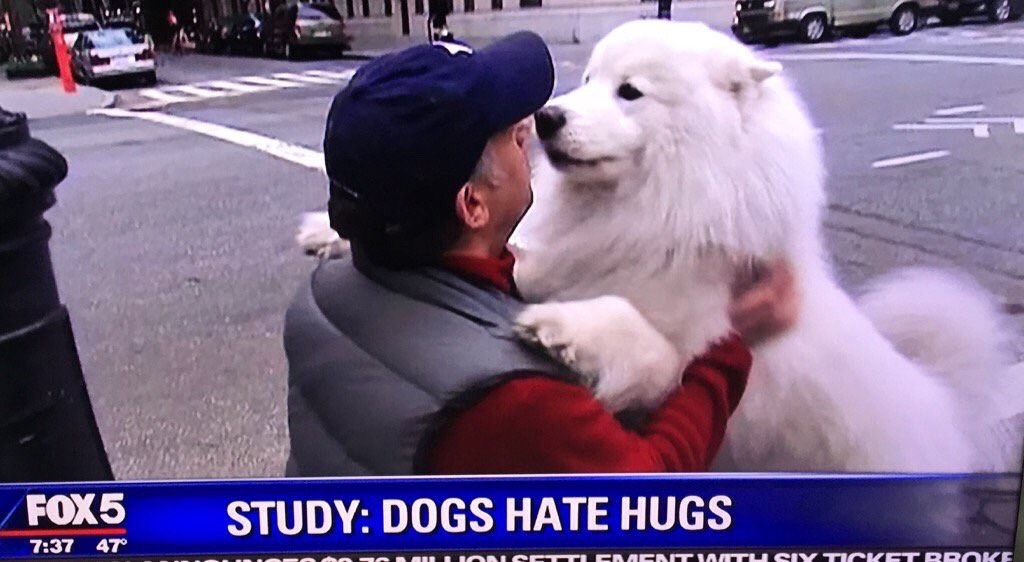
As a dog trainer, I can tell you that probably 50% of dogs really don’t like hugs and at least another 48% pretty much just tolerate them. Very few dogs I know genuinely like hugs the way humans tend to give them. What’s funny is that the picture that Fox used with this headline is one of the more common ways dogs do enjoy contact that humans would consider a hug.
Stanley Coren – the dude who wrote the article that is pissing everyone off about this – really does know what he’s talking about. He wrote one o my favorite books, called how to speak dog, which has some absolutely beautiful diagrams of dog behavior and body language along the gamut of extreme situations.
The way humans hug dogs is often really uncomfortable for them. We lean over them and trap them (think how many dogs we already know are spooky when you loom over them, but are fine if you get down to their level), and then we restrict their ability to move and shove our faces close to theirs. That’s not fun. Keep in mind that most dogs have personal space bubbles that are larger than we tend to think, and now you’re not only invading it, you’re making it so they can’t move or defend themselves if something happens.
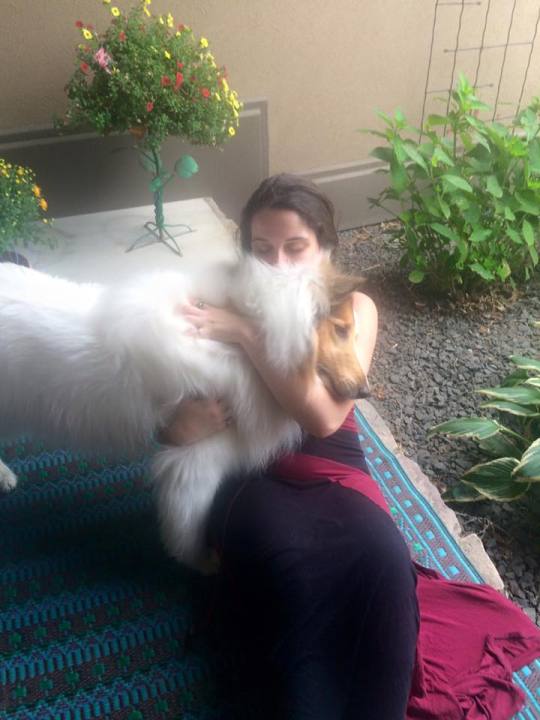
Look at this photo from a couple years ago. Avalanche is probably the most tolerant dog I know of things that press his physical boundaries – he lets little kids do things to him that make me cringe and doesn’t even seem to notice half the time. This was right before I had to head back to college and I knew I wouldn’t see him for another 6 months, so I hugged him because sappy human emotions. I have an amazing relationship with this dog, and look at his body language. He’s kinda stiff, his face is a little tense, and the corners of his mouth are pulled back a little. All in all, he’s supremely un-enthused but he’s letting me do it. After about five seconds, he huffed out the sigh he uses to let me know when he’s done with the hug, and then pulled back and shook off.
Most dogs learn to tolerate hugs because we do it to them so often. It’s pretty much a kind of learned helplessness, plus, they like us and so they put up with our stupid human behavior. When you hug most dogs, you’ll notice they get kinda stiff, they look away or at other humans for help, you’ll see side-eyes or look-aways (not whale eye). Often they’ll distract you by doing something else like pawing at you, or licking your face as an appeasement signal. They’re all signs of discomfort that we already routinely ignore when we deal with our dogs, so it makes sense that people think their dogs are fine with it – they’re just still not listening.
More often, you’ll get dogs that will crawl up your chest when you sit and put their paws on your shoulders. Sometimes their face is close to yours, sometimes it’s on your shoulder. In that position – which they often initiate – they ca easily withdraw and get away if necessary and they’re not trapped or being leaned over. It’s not really a hug, just close contact, but I think it’s about as close as humans are going to get to one that a dog will enjoy.
Today is Copernicus’s 540th birthday. You may remember Copernicus as the man who said “Hey, what if the Earth went around the sun?” To which the Catholic Church replied “Hey, what if we set you on fire?”
I hate to be ‘that guy’, but the Catholic church never threatened him. His calendar reform and his ideas on heliocentricism weren’t even discussed at the Council of Trent and his works were seen as uncontroversial. Copernicus never faced any persecution directly or indirectly by the Holy See. In fact, Pope Gregory XIII used Copernicus works on heliocentrism to reform the calendar in 1582. It was only 75 years later that it was even brought up again by Galileo. The pope at the time was a conservative one and the Catholic church was desperately trying to counter Protestantism and the thirty years war, hence why the pope and the inquisition placed him under house arrest on suspicion of heresy, using Copernicus’ theories as their argument against him.
Emily Temple-Wood, a biology major at Loyola University, started WikiProject Women Scientists in 2012 in an attempt to combat the sweeping underrepresentation of women in the annals of scientific discovery.
The trolls soon descended, but instead of retaliating in kind, Temple-Wood and the followers she’s acquired write a biography on a woman who’s made a valuable contribution to science for every hateful message she receives. It turns out, her efforts are desperately needed.

















 Waiting for Winter