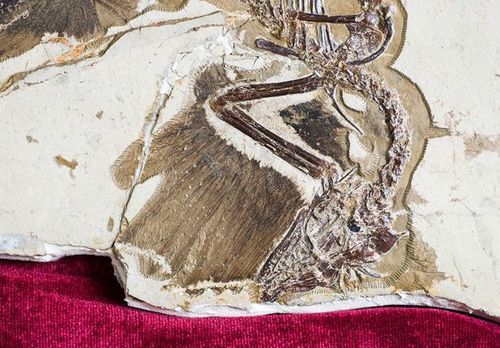
See those feathers? The skeleton they found was so well-preserved that scientists were able to examine the pigment cells in the feathers and compare them to those of modern day birds.
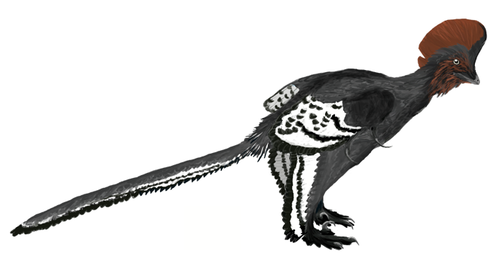
And they were able to do this with such accuracy that they know the coloration of this dinosaur. In life it looked something like this.
It just baffles me that we know the color patterns of an animal that has been dead for 161 million years
Ah, you have met the horror that is BANDitry. Let me explain.
This is going to turn into a rant, not against you, ANON, but against BANDits.
What is a BANDit, you ask?
A BANDit is an individual who abides by the saying “birds are not dinosaurs.”
“Alright,” you say, “So… if the scientific consensus says birds are dinosaurs… who are these people? Do they have a legitimate point? Are they being silenced by the majority, are people trying to pretend they don’t exist because they don’t like their theories? Could they be right?”
Short answer: No.
Slightly longer answer: Fuck no.
Actual answer:
Hoooooooooooooooooo boy howdy do let’s all go through this wonderful hellscape together as a group because we’re going to have a HISTORY LESSON
Dinosaurs and evolution both became things in the public eye around the same time. How about that, right? I mean obviously we’ve known about non-avian dinosaurs before that – bones have been found by various groups of people around the world for ages. Birds exist. Evolution is also an idea that has been around for ages. Plenty of people have theorized that life changed over time. Darwin himself built on a lot of growing thought that had occurred due to the Enlightenment. What Darwin’s book did was transform the discussion on biological origins by providing a wealth of evidence and a mechanism by which life could change. But that’s neither here or there and not the point of this. Evolution’s validity is decidedly a topic for another day (spoiler alert: it’s valid. It is extremely valid. It is so valid that gravity has less data backing it up. Creationists are literally delusional. I am not afraid to say this.)
The first dinosaur was that officially described as such in a scientific journal was Megalosaurus and was described by William Buckland in 1824. Iguanodon, the second dinosaur to be described, was done so by Gideon Mantell in 1825. These “great fossil lizards” were called, as a group, “dinosaurs” by Richard Owen in 1842. Soon, many more dinosaurs were found – Hylaeosaurus had already been found, and then many were found in the United States.
In 1859, Darwin published On the Origin of Species. Reaction in the scientific community was, admittedly, mixed at the time; but it did turn the tide in the favor of evolution. The main discussion turned from being about whether or not things had evolved and rather, how they evolved. Richard Owen, the coiner of the term Dinosauria, didn’t actually disagree with evolution itself as is commonly purported, but rather thought the mechanism behind it was more complex than Darwin said in his book (still, many of his theories were very controversial).
People had a lot of… false ideas about evolution at that time that were hard to rule out without molecular biology or the extensive body of data that we currently have. One of them was Dollo’s law of irreversibility. This thought stated that evolution is not reversible. It was created in 1893 and basically more formally it says “An organism is unable to return, even partially, to a previous stage already realized in the ranks of its ancestors.” This is… well, it’s not really a good theory. It’s based around the idea that it’s so improbable that an evolutionary structure should evolve twice, that it should be ruled out that it would. And while its true that it is improbable, that’s given that the genes for that thing are lost – though we do lose and modify many genes, many other genes are actually silenced in our genome and can be turned back on by mutations, etc. So while it is an important thing to consider, it doesn’t always apply… like some things are probably irreversible (such as general body plan – bilateralism, deuterostome versus protostome, etc,) small features really are not. Evolution kind of runs in one direction… except when it doesn’t
In the rush of evolutionary theory, people were rapidly looking to see how major groups of organisms evolved. One of these was, of course, birds. Very early on, Thomas Henry Huxley, one of Darwin’s main supporters, saw that Archaeopteryx was decidedly similar to dinosaurs such as Hypsilophodon and Compsognathus. He was the first to propose an evolutionary relationships between the two in the early 1870s, and many people supported his ideas, such as Baron Franz Nopcsa. Richard Owen and Harry Seeley, however, disagreed, and thought the similarities were due to convergent evolution.
Fast forward to the late 1910s. Gerhard Heilmann publishes a book on the Origin of Birds. He noted that theropod dinosaurs such as Compsognathus were the most similar to birds. However, he noticed that birds had their clavicles fused to form a bone called the furcula. Clavicles, however, had not yet been noted in theropod dinosaurs, but they had been found in more primitive reptiles. Thus, according to Dollo’s Law, Heilmann thought that dinosaurs and birds couldn’t possibly be related and any similarities were due to convergent evolution. He instead proposed “theocodonts” as the ancestors of birds. His conclusions were then accepted by almost everyone until the 1950s due to the thorough nature of his book.
This is the first horrifying moment in dinosaur-bird stories. Clavicle bones are actually extremely delicate bones and get destroyed and damaged easily – especially in fossils. Often, this occurs to make them unrecognizable. At the time of Heilmann’s book, not only had clavicles been identified in primitive theropods such as Segisaurus, but there were clavicles in other dinosaurs that had simply been called other things. Up until 2007, this structure has been found in all types of theropods except the most basal ones (Eoraptor and Herrerasaurus), and this structure has also been found in the sauropodmorph Massospondylus.
But the damage had been done. Everyone believed Heilmann, did not look further into clavicle bone structure, and the seed of doubt was planted. Just think what would have happened if we had recognized clavicles for what they were and had a whole half-century of dinosaur-bird research.
I don’t even really like Adele but that was amazingly relevant
Alright so now its the 1960s… Civil Rights movement, peace and love, a series of terrible situations set forth by Kennedy and other presidents leading to the literal quagmire of Vietnam, fun shit. A lot of things changed in this decade. Just ask my parents, who were there, and have stories (my dad was at the democratic convention of 1968. Look that shit up.) You know what else was also changing?
Dinosaur paleontology
In 1964, a new dinosaur was discovered and then described in 1969. This dinosaur was small, it was lithe, it had hands and a skeleton similar to that of a birb… and it was Deinonychus. Around the same time, a specimen of Pterodactylus was redescribed as a specimen of Archaeopteryx… how they got it that wrong is baffling to me, but it had similar wrists to Deinonychus.
John Ostrom, the describer of Deinonychus, immediately made the EXTREMELY OBVIOUS CONCLUSION: dinosaur-bird link may actually be a thing. This is great that he did this, but other bird like dinosaurs had been known for ages… like Velociraptor. Thank God Ostrom made the connection when he did.
This was the Dinosaur Renaissance, and a LOT of other things came to light during this time – basically dinosaur paleontologists stopped fucking around. Look, some idiots decided that dinosaurs were obviously “overgrown, sluggish, dumb lizards” and no one thought to challenge this assumption until the 1960s. Call it what you will – status quo, mammal bias (because lizards are ANYTHING but dumb), people enjoying the image of “dumb monsters” – but it set back dinosaur paleontology during those 50 years in ways other than the bird-dinosaur link. Dinosaurs were reestablished as monophyletic (meaning, Saurischians and Ornithischians do share a common ancestor to the exclusion of other groups – many though prior to this that the erect gait common to both had evolved twice) – dinosaurs might have been warm blooded (further studies have shown that all were close (mesothermic) if not outright endothermic) – dinosaurs moved in social groups, cared for their young, and had social behavior in general – non-avian ones probably went extinct due to a meteor impact rather than the “failure” of NADs as a group – dinosaurs probably didn’t walk like lizards and had mammal and bird like postures (including tails that WERE VERY MUCH UPRIGHT – I’M LOOKING AT YOU, JURASSIC WORLD) – etc.
So this was a great time for dinosaurs, and an even better time for birds.
In the 1980s, paleontologists started to use cladistics, the most wonderful thing in the universe (I’m not kidding right now.) Cladistics is a method of arranging species based strictly on their evolutionary relationships, using statistical analyses of their physical (and oftentimes, molecular) characteristics to do so. Jacques Gauthier and others used this to show, unequivocally, that birds were a derived group of theropod dinosaurs, with dromaeosaurids very closely related to them. This has been confirmed in many more analyses since, and this first one was made before feathered non-avian dinosaurs had been discovered
Now, the 1990s. China, sadly, in the past was unavailable for paleontological research – but when China opened up, all of that changed, and researchers flooded in. And hoo boy, they found so much. So many feathered dinosaurs have been found in China, such as Sinosauropteryx, Caudipteryx, Protarchaeopteryx, etc. etc. etc. etc….. And the evidence seemed pretty damning. Developmental studies of birds briefly cast a light on whether or not dinosaur finger evolution matched that of birds (which digits got shortened and which lengthened, etc.,) but the discovery of Limusaurus showed that, in fact, theropod dinosaurs had the same fingers go through shortening and lengthening in their evolution as birds did. They had clavicle bones. And, looking at the statistical evidence, there are so many similar structures between theropod groups and birds, that it is unequivocally certain that birds are a modern group of theropod dinosaurs. There is no “maybe”. This has as much data backing it up as evolution or genetics or gravity.
Here is a short list of the evidence (because, frankly doing a detailed study is another post):
Feathers. Dinosaurs have been found extensively with feathers. From compsognathids to raptors to freaking ornithischians, dinosaurs have feathers. Only one group has been found with a similar integumentary structure – pycnofibres on pterosaurs. Pterosaurs have not, however, been found with pennaceous feathers – the feathers with vanes, barbs, etc. that we typically think of when we think of feathers. Dinosaurs have been. The fact that we have no other animal group found with feathers is really indicative that dinosaurs include birds
The skeleton. Many dinosaurs had extremely bird like skeletons. These include Sinornithosaurus and, of course, raptors. They had similar necks, pubises, wrists, arms, girdles, shoulder blades, clavicles, and breast bones.
Lungs. Theropods very far removed from being birds – like Majungasaurus – have been found with features indicating that they had a similar intricate lung system as birds. This lung system is unique to birds – and now dinosaurs.
Sleeping Posture. Dinosaurs such as Mei and Sinorithoides have been found in fossilized positions that indicate they slept like modern birds, with their heads tucked under their arms.
Reproduction. Birds grow the medullary bone when laying eggs. This same feature has been found in Allosaurus, Tenontosaurus, and Tyrannosaurus – and only Tyrannosaurus is anywhere near closely related to birds. The medullary bone has not been found in any other animal group.
Care of young. Many dinosaurs (such as Citipati) have been found sitting on the neck much like brooding birds. Many dinosaurs also cared for their young much like birds did, and some dinosaurs required parental care when young (like some types of baby birds).
Gizzard stones. Many theropod dinosaurs have been found with them.
Soft tissue evidence. Scipionyx, a small coelurosaur, was found with soft tissues – and there is some soft tissue known from Tyrannosaurus. It was foudn that there were blood vessels, bone matrix, and connective tissue, which retained fine structure, and study is ongoing. However, some looking into this has shown similarities in peptides between birds and dinosaurs.
There’s the fact that no other group of animals shows enough similarities and evolution to be considered a contender for the title – no other group shows a similar evolutionary trajectory as dinosaur do for birds
So what is up with BANDits?
Bandits are a niche group of scientists who decided that they didn’t like the birds are dinosaurs hypothesis (when it was a hypothesis, which it is NOT now, its a theory, its a scientific consensus) back when it didn’t have as much data as it does now. But, rather than change their point of view with changing evidence, they have continued to insist that they are right and conduct crappy science to prove it.
They keep pointing to Longisquama, a fossil of a weird lizard-looking-like thing with fronds, as a bird ancestor. However, the fossil is REALLY SHITTILY preserved – multiple people have affirmed that you can’t actually gather anything from the fossil. The fronds might not even be integumentary structures – I personally am convinced they were leaves that happened to be next to the thing when it died. Furthermore, if Longisquama was the ancestor, there would be a huge gap between that and the first appearance of a bird with no “intermediate forms”. Dinosaurs have a detailed evolutionary history between A (non avian dino) and B (borb) – you can just look at my blog to see this!
Their other main source of birb ancestors are all… Dinosauromorphs. You know, the animals most closely related to dinosaurs? So a) those also have a “ghost lineage” (meaning no forms between A and B) like Longisquama because they went extinct and b) it’s really pedantic, it really is what is the definition of a dinosaur, then
Feduccia in particular is pretty terible in offering up an alternate hypothesis for waht could have “evolved into birds” – he literally has no legitimate alternate idea, which you kind of need to disprove something with as much evidence as the BAD (birds are dinosaurs) hypothesis
Czrkas doesn’t have a degree MAKING ME MORE QUALIFIED THAN HIM
They try to argue that maniraptorans – such as Scansoriopteryx – aren’t dinosaurs – when this is false. But they recognize that this group is clearly bird-relative and don’t like that they’re dinosaurs. It’s that simple. But things just outside the maniraptoran group – such as ornithomimosaurs – and things like Compsognathus – A) have feathers and B) are extremely similar to maniraptorans. So then if you include those in “bird relatives that ARENT DINOSAURS,” you include things like T. rex. But then you have animals similar to those who are clearly related that you’d have to lump in, and then you have animals similar to those you’d have to limp in, and –
this leads me to CLADISTICS. Feduccia does not conduct cladistic analyses, and BANDits in general do not conduct them well. Cladistics is our best tool to track evolutionary relationships as is uses probability and qualitative measures to analyze how traits such as bone structure, soft tissues, and genes that are similar could lead to evolutionary relationships, and which are just convergent. When a cladistic anaylsis is conducted properly – meaning without bias and with as many characters to analyze (traits) as possible – BIRDS COME UP AS A GROUP OF DINOSAURS. This means that it is MORE LIKELY that birds are dinosaurs than they are ANY OTHER GROUP. Fedduccia and co use qualitative analyses that aren’t cladistics based – meaning – they basically go “I don’t think birds are dinosaurs because this one single thing isn’t similar so even though all these other things are I don’t care I’m going to say they’re not anyway.” When they DO do cladistics – like in James and Pourtless’ analysis – it is shitty, biased (meaning they leave out important characters to get the result they want,) and have results that have been disproven extensively (and oftentimes they still can’t make maniraptorans not group up with birds no matter how biased their analysis)
They use “Protoavis” which is basically a CHIMERA aka NOT A REAL ANIMAL – to strengthen their BANDitry, which is ridiculous because
They accuse BAD paleontologists (again, Birds Are Dinosaurs, not “not good” paleontologists) of using chimeras in their analyses because of Achaeoraptor, even though that doesn’t prove that other fossils from China are hoaxed, and BAD paleontologists acknowledged it was a hoax pretty fucking quickly
They think feather impressions are collagen fibers… when we know what collagen fibers fossilized look like from lizards and frogs… they aren’t fuzzy… which the protofeathers and feathers of dinosaurs ARE FUZZY
They only get their papers published when they’re peer reviewed… by other BANDits. And not people who disagree (aka real scientists). This is bad. This means they get their papers published despite bad science and incorrect conclusions. This is the opposite of what peer review is supposed to do. Early BAD (birds are dinosaurs) people had their papers reviewed by people who disagreed AND agreed with them – leading to their conclusions being much more robust, because they stood up to a wide range of biases when looked at.
They think they’re being oppressed. Because they disagree. Even though. They don’t have any real evidence to back up their opinions. People listened to them for one hundred years. They stopped when they no longer had enough conflicting evidence to make the birds are dinosaurs hypothesis invalid. Lingham-Soliar, for example, is outright deranged. He compares scientists who think that birds are dinosaurs to Nazis, Stalin, Apartheid, and Charlie Hebdo… which even if the BAD hypothesis was incorrect… IT IS NOT AS BAD AS NAZIS AND GENOCIDE HOLY SHIT. His book on integument has a chapter on freedom of speech and the first amendment… meaning he knows he’s wrong but he’s defending his right to publish lies, apparently. And he outright ignores other researchers and accuses them of lying… which… they had proper peer review… meaning people of all different points of view reviewed their papers… and deemed them scientifically valid… so… and he accuses everyone of hiding evidence that supports him… so…
This isn’t science. This is being delusional. They’re stuck in the past, which was based off of shitty science as it is, and refuse to change their worldview.
And the worst part is? Their shitty science is often used by Young Earth Creationists to bolster their shitty opinions as well!!!
So what do we do, as real scientists, who look at scientific evidence, and think about it, and test it? We continue to find evidence that birds are dinosaurs, and publish it accurately, and not cut corners, and continue to do things right, and just bury BANDits into the ground in their own illegitimacy and backwards-ness.
Don’t worry about them, anon. No one pays attention to them anymore, except to get pissed at them.
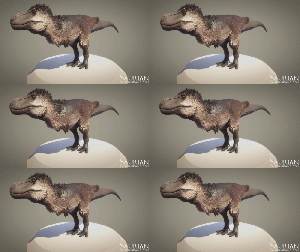
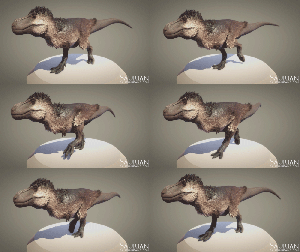
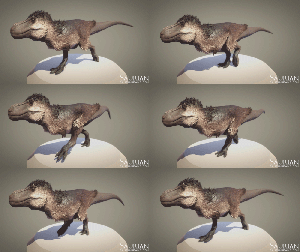
Fresh animations for our newly released Tyrannosaurus. We are all extremely proud of this design and are pleased to show you guys the fruits of our labor.
yeah not sorry, he looks dumb as shit. nuke the dumb feathers and weird beak head.
1) that “weird beak head” are actually lips like on a modern day monitor lizard 2)feathers are not dumb, they are used to help cool,insulate,and camouflage the tyrannosaurus.
I’m gunna just call you retarded. T-rex never had feathers and the weird beak head is not even remotely similar to the slender and tight cornered maw of a monitor lizard
I really wish I could edit posts, because I then could cross out the r word on your post, which is highly offensive and you shouldn’t use that word, but here goes.
A) This is an accurate T. rex in every respect, and I mean though the feathers are speculative, this is a very likely configuration for them
B) The lips do look like a monitor lizard. I honestly don’t know what monitor lizards you’ve seen in life.
C) Are you aware that Tyrannosaurs are very closely related to birds, and they were probably very similar to birds, much more so than monitor lizards?
D) You do know that dinosaurs were living animals and that them being “cool” or your pre-formed idea of them is not accurate and they have no obligation to be the scaly almost-godzilla monsters that you want them to be?
E) If you want games and things with tyrannosaurs like you want them to be (re: not real animals,) there are plenty of them. Hundred even. This is accurate, and yet, not the majority of representations. If anyone has a right to be mad, it is us.
Sincerely,
Someone who knows much, MUCH more than you about this subject, and is much, MUCH more qualified than you to talk about it.
oh yes, I am sure you are totes magotes a paleontologist with a masters degree in biology. sorry, I forgot we’re dealing with the INTERNET here for a second, where everyone thinks they’re qualified to talk fake ass shit and claim to be right!
No evidence of #1 to support your silly claim
and have you even studied reptiles?
You know when you make half-assed claims about animals you clearly know nothing about you just look like a goddamn idiot right?
This friends, is a monitor. Note the distinct lack of dumbfuckingRETARDbeak. Note the LACK OF LIPS. You wanna do an animal justice? Then do it RIGHT.
Yooooo. You look pretty ignorant when you keep going WHY DOES THE T-REX LOOK LIKE IT HAS A BEAK WHEN MODERN REPTILES LOOK DIFFERENT?
T-rexes are much more closely related to modern birds than reptiles. Other posters have covered the studies on this so, I won’t. I’ll link them though, so you won’t cherry pick and be like WHERE IS UR PROOF.
Anyway.
The reason a t-rex’s nose look’s kinda beaky is because it is literally what beaks evolved from. I even went ahead and linked an NPR article on the subject there so if you don’t want to wade through a mega dry jargon laden academic paper you can just read that. Or if you don’t have a university to give you access to academic journals without paying a ton of money. And if you DO want to read the academic version there is a link to it in the NPR article. See? That bit at the bottom linking to Evolution?
(I also want to address how screwed up the concept of an ‘expert’ you’re presenting is. Hi. I am finishing my master’s degree. On the last leg of my thesis. Not in paleontology, but in sociology. Which means that in your mind even though I’m apparently not qualified to talk about dinosaurs I am qualified to talk about the social construction of an ‘expert’.
I’m going to avoid listing off books about academia en masse here because I deeply suspect you’re not going to read them. However I am going to mention one particular sociological theorist: Pierre Bourdieu. If you want to read an awesome takedown of the practice of academic gatekeeping of knowledge, the place of the so-called ‘expert’ in society, and the multitude of flaws in academia in terms of perpetuating societal inequalities then he is the dude to read. (Especially Distinction. Which people should be reading anyway like seriously go read Distinction it’ll change your life, man.)
ANYWAY. All of this to say that the idea of the expert in society is a joke, especially with the presence of the Internet. Like. Hi. I am one of the foremost experts of the sociology of play. Like probably top 100 people in the world who know about this subject. How… how did I achieve this state of expertness? I’ve read Callois and Huizinga – who have written basically the two books on play as theoretical concept in sociology. I’ve done a couple of lit reviews on the subject. I’ve read some modern works including Gary Alan Fine’s study on tabletop RPGs (another book everyone should read!) and Patricia Masters’ study on mummers in Philadelphia.
And I’ve done my own research. However clumsy and halting. See that aforementioned thesis?
I want to address here is that the main reason I’m an ‘expert is because very, very, few people study play in a sociological context. That is literally how you become an expert. You read a lot on a subject until you start running out of stuff to read… and then wow. You are probably educated on a subject as well as you would be if you got a bachelor’s degree. Probably a little bit better! If you do your own research – even if it is work done in the realm of theory – then, congrats, you’re as well educated as a master’s student. If you’ve done enough research to write a book on the subject that significantly would add to the state of knowledge in your field? Wow. You are basically as educated as a freaking PhD.
Academia does have a place in all of this in terms of, a) providing ethical review boards to make sure research does not occur in less-than-great circumstances, b) legitimizing research via the peer review system and c) providing students with connections and mentors. This doesn’t mean you CAN’T gain the same level of education outside of academia so plz shut up about how a-dinosaur-a-day can’t possibly be educated about basic paleontology if they haven’t got a university degree to wave in your face.)





 Waiting for Winter