thefingerfuckingfemalefury:

thedevilspanties:

spart117mc:

viridieanfey:

romanimp:

beatnikdaddio:

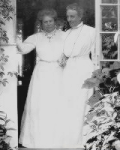
admiring the stockings. 1940’s.

#[40S COMMERCIAL ANNOUNCER VOICE] WHAT’S BETTER THAN THIS? GALS BEING PALS

Fun fact: Though being gay in the 40s sucked, being gay in the military was easier, and pretty common. There were apparently, at one point in time time so many lesbians in the military that when they tried to crack down on it, the girls wrote back and said “Look I can give you the names, but you’ll lose some of your best officers, and half your nurses and secretaries.” And they pretty much shut up about it unless you were especially bad at subtlety. (Source: Odd Girls and Twilight Lovers. A good source for gay history from 1900s onwards.)

Sergeant Phelps worked for General Eisenhower. Four decades after Eisenhower had defeated the Axis powers, Phelps recalled an extraordinary event. One day the general told her, “I’m giving you an order to ferret those lesbians out.’ We’re going to get rid of them.”

“I looked at him and then I looked at his secretary. who was standing next to me, and I said, ‘Well, sir, if the general pleases, sir, I’ll be happy to do this investigation for you. But you have to know that the first name on the list will be mine.’

“And he kind of was taken aback a bit. And then this woman standing next to me said, ‘Sir, if the general pleases, you must be aware that Sergeant Phelps’s name may be second, but mine will be first.’

“Then I looked at him, and I said, ‘Sir, you’re right. They’re lesbians in the WAC battalion. And if the general is prepared to replace all the file clerks, all the section commanders, all of the drivers—every woman in the WAC detachment—and there were about nine hundred and eighty something of us—then I’ll be happy to make the list. But I think the general should be aware that among those women are the most highly decorated women in the war. There have been no cases of illegal pregnancies. There have been no cases of AWOL. There have been no cases of misconduct. And as a matter of fact, every six months since we’ve been here, sir, the general has awarded us a commendation for meritorious service.’

“And he said, ‘Forget the order.’

– The Gay Metropolis: The Landmark History of Gay Life in America

I’ve reblogged this before but it didn’t have these comments and HOLY HOT DAMN DID IT NEED THEM.

This is my most favourite of stories about this time period okay ❤

oenanthic-ether:

the-real-seebs:

cuddleah:

A coworker asked me if i was going to our local pride “they’re doing a drag thing before the Rocky Horror showing"
I, quite calmly, went. The fuck. Off.
Told her exactly what I thought of Drag, RHPC, and cis peoples fascination with them both. Surprisingly only dropping one F-bomb.
She was shocked af, I’m usually all smiley happy upbeat girl, even on the worst days i can usually fake positivity.
She came back and tried to “its not that bad” and “is all in fun” and crap. I shut down everything she came up with. I would like to take this opportunity to thank tumblr for prepping me for that moment. 🙂

It’s always weird trying to transition between real-world LGBT spaces and tumblrized LGBT spaces.

In the rest of the world, Rocky Horror is a thing which has been a clearly positive transformative influence on probably a majority of the LGBT people I’ve known, does a lot to undermine gender assumptions, and is the specific thing that got at least some people I know to realize that they were trans.

On tumblr, it’s “problematic”.

In the rest of the world, drag undermines the gender binary and drag communities are where a lot of trans women first find some kind of acceptance or comfort, and are generally well-regarded.

On tumblr, drag is horrible and drag communities are horrible and the people who found those communities to be safe and welcoming don’t count because their narrative doesn’t fit some academic theory about the right way to be trans.

In the rest of the world, the stuff being done at pride events is usually understood to be at least predominantly organized by and catering to the LGBT community.

On tumblr, that’s “cis people’s fascination”, and the LGBT people involved with it are completely erased.

In the real world, you’re a fucking asshole.

On tumblr, you imagine that you “shut down” everything she came up with by being ignorant of LGBT history and being rude. But I suspect that anyone else who’d overheard the conversation would have thought of it rather differently.

Gosh, I sure hope we can progress towards the idealized utopia you envision where nonbinary filmmakers don’t get to make the films that they want to, and we can always judge every work of art by the very latest cutting-edge standards, and never consider how our history got us where we are today.

How the fuck can you be in your 30s and not know better than this? It’s one thing when it’s the 16-year-olds who genuinely have no idea what life was like in the past, but you ought to be old enough to remember this. I guess maybe not; the point at which the people I mostly talk to were going to RHPS woulda been the late 80s, and back then, “two hours a week where you aren’t worried about being killed for dressing to the wrong gender norm” was a pretty amazing thing.

ALL OF THIS RESPONSE IS LIKE A RELIGIOUS EXPERIENCE THANK YOU!!!

fieldbears:

wildwomanofthewoods:

mindblowingfactz:

In a private cemetery in small-town Arkansas, a woman single-handedly buried and gave funerals to more than 40 gay men during the height of the AIDS epidemic, when their families wouldn’t claim them.
Source

One person who found the courage to push the wheel is Ruth Coker Burks. Now a grandmother living a quiet life in Rogers, in the mid-1980s Burks took it as a calling to care for people with AIDS at the dawn of the epidemic, when survival from diagnosis to death was sometimes measured in weeks. For about a decade, between 1984 and the mid-1990s and before better HIV drugs and more enlightened medical care for AIDS patients effectively rendered her obsolete, Burks cared for hundreds of dying people, many of them gay men who had been abandoned by their families. She had no medical training, but she took them to their appointments, picked up their medications, helped them fill out forms for assistance, and talked them through their despair. Sometimes she paid for their cremations. She buried over three dozen of them with her own two hands, after their families refused to claim their bodies. For many of those people, she is now the only person who knows the location of their graves.

How have I never heard of this?

People like her should be remembered. And even more importantly, we must remember that there was a time in our history when we needed someone like her.

daughtersofsappho:

Boston Marriages

Boston marriages – romantic unions between women that were usually monogamous but not necessarily sexual – flourished in the late nineteenth century. The term was coined in New England, around the time that numerous women’s colleges such as Vassar, Smith, and Wellesley emerged.The concept of love between women was, of course, not new; “Boston marriage” and the very similar, earlier nineteenth-century term “romantic friendship” connote a type of relationship that dates back to at least the Renaissance in the West, and possibly further in the non-Western world. Boston marriages signified a new phenomenon, however, in that the women involved in them tended to be college-educated, feminist, financially independent, and career-minded – hardly the social norm among females of the day. These characteristics distinguish women bound together in Boston marriages from participants in the earlier romantic friendships.

Boston marriages were long-term and committed, and resembled traditional marriages in many ways. But remaining unattached to men gave women a chance to attain significant decision-making power over their own lives, power they would have forfeited to their husbands in a conventional marriage.The social acceptance of the Boston marriage was predicated upon the common assumption that the women involved did not practice any form of genital sexuality with each other. At the time, sexologists had not begun the regular use of pejorative terms such as “sexual inversion” and “perversion” to decry homosexuality, and the term “lesbian” was not yet in popular usage. Since nineteenth- and early twentieth-century women were often considered not to have strong sex drives – sex for them was supposedly a duty, and intended for procreation only – nothing was deemed wrong with women’s public displays of affection. Neither were their sharing households and even beds considered suspicious.Whether women in these romantic relationships did indeed refrain from sexual contact with each other is difficult to determine, but it is very likely that some, if not all, of Boston marriage couples were physically as well as emotionally involved. Their love letters to each other often indicate a passion that could hardly be considered platonic, and modern lesbian historians and writers have speculated that if members of Boston marriages were alive today, they would openly identify as lesbian.

– Teresa Theophano [X]