jennytrout:

ccoastal:

hanars:

luckykrys:

thecreach:

luckykrys:

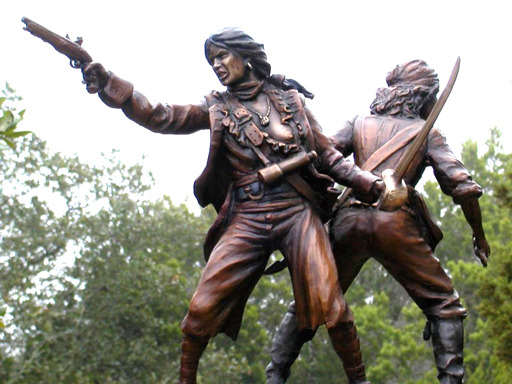
“Anne Bonny and Mary Read were pirates, as renowned for their ruthlessness as for their gender, and during their short careers challenged the sailors’ adage that a woman’s presence on shipboard invites bad luck.”

Sculpture by Erik Christianson.

I’m not entirely sure that the statue really needed to have a tit out.

How dare women try to have nipples.

Actually I’ve seen this before and I can tell you— it’s because these women were bad ass pirates and when they killed someone they’d expose one or both breasts so that when their victim died, (s)he knew that they were killed by a woman.

ACTUALLY Anne Bonny purposely wore loose fitting clothes and displayed her breasts openly at all times during battle – mainly because men were distracted by them, and she took pleasure in killing said men while they were too busy staring at her breasts. Mary Read dressed mainly as a man (after posing as her deceased brother, Mark, for the entirety of her childhood) and both ladies cross-dressed from time to time, hopping between ships. They were known as the ‘fierce hell cats’ due to their ferocious tempers, and were key elements to Captain ‘Calico Jack’ Rackham’s crew – they were the only two known female pirates in the Golden Age of Caribbean piracy. IN FACT, when the ship was captured by the British Navy, Anne and Mary were the ONLY TWO pirates who fought while the males of the crew hid – they were all tried to be hung as pirates but Bonny and Read were both pregnant and were pardoned.

Calico Jack was a lover to Bonny, and as he was to be hung, Bonny’s final words to him were, “Had you fought like a man, you need not be hung like a dog.” Bonny and Read were possibly two of the most badass fucking pirates and they were FEMALE. The more you know. 

And on top of all that, exposed breasts have a long and storied history of symbolism in art. They mean all sorts of things. The sculptor may have chosen to expose her left breast specifically to denote her courage–her heart is exposed–or to evoke comparison to Amazon warriors, who cut off their right breasts.

Titties are complex in art.

neil-gaiman:

medievalpoc:

joannalannister:

Women in medieval guilds:

All sorts of tools have been found in pre-Christian women’s graves. The only major craft which seems to have been restricted to men only was Blacksmithing. […]

Here are a few examples of jobs done by women in the medieval period:
brewer, laundress, barrel and crate maker, soap boiler, candle maker, book binder, doll painter, butcher, keeper of town keys, tax collector, shepherd, musician, rope maker, banker, money lender, inn keeper, spice seller, pie seller, woad trader, wine merchant, steel merchant, copper importer, currency exchanger, pawn shop owner, lake and river fisherwoman, baker, oil presser, builder, mason, plasterer, cartwright, wood turner, clay and lime worker, glazier, ore miner, silver miner, book illuminator, scribe, teacher, office manager, clerk, court assessor, customs officer, porter, tower guard, prison caretaker, surgeon and midwife. […]

There are records of women traders in 1205 in Genoa, Italy. In fact, 21% of people involved in trade contracts there in the 13th Century were women. Women also provided 14% of capital in seafaring ventures at the time.
Even earlier, in the 12th Century, there are records of women traders in Georgia, Eastern Europe. Paris tax registers for 1292, 1300, 1313 list lots of craftswomen, many of whom were in different trades to their husbands. […]

Girls might be educated at home, with private tutor, or at a Convent. There were also schools within towns. In some cases girls were excluded from these, or only allowed to enter elementary schools. In other cases they were allowed to enter secondary schools and obtain a much broader education, including Latin and other languages. Some schools were mixed, others were single sex. Town Councils and the Church had some control over schools and over the appointment of teachers. In 1388, a Jewish woman, Sarah of Gorlitz, donated a property to be used as a school for Jewish children. 

Outside of the Guilds, women might be employed as unskilled labourers in vineyards, on building sites and so on. Many more women than men were employed because they could be paid less for doing the same work.
In Wurzburg, 1428-1449, for example, there are records of 323 female building site workers, paid 7.7 pfennings a day, and 13 male building site workers, paid 11.6 pfennings a day. In general, it seems that a wide range of professions were open to medieval women, although they were also subject to a variety of restrictions.

Women artists in the medieval period

Women poets throughout history

Women writers by historical period

Medieval women physicians 

Women in medieval warfare

Women travelers / pilgrims / explorers in the medieval period – “Stronger than men and braver than knights”

If anyone’s curious, uncovering the 19th and 20th century erasure of women’s contributions to the creation of medieval European illuminated manuscripts is what started me down my current slippery research slope sometime in 2009-2010. There was a school in Paris with a majority of women illuminators and scribes c. 1300.

P.S. Herrad Von Landsburg is my eternal fave:

image

A really important reminder for those of us who write fantasy or historical fiction…

Haiti and the United States

publius-esquire:

haitianhistory:

Hello, while we have kept you updated with posts about the U.S. Occupation of Haiti, I simply wanted to take a small break from that to share a few titles with you on another topic of great interest, that is, the ‘diplomatic’ relations between Haiti and United States during and after the Haitian Revolution. I put diplomatic in quotation marks since, from the time of Jefferson to the Civil War, Haiti and the United States did not enjoy formal diplomatic relations (given that Haiti’s independence as a state was not recognised). 

Although there seems to be this view that Haiti automatically existed in antagonism with the United States (which is not so completely false),  if we accept this too wholesomely, I think we risk missing out on the complexity posed by Saint-Domingue/Haiti to a country like the United States. Literature on American-Haitian relations suggests that different American administrations dealt with Saint-Domingue/Haiti well, differently. Indeed, it is very interesting to see how the U.S. had to reconcile the principles of its own revolution with the advent of a free black state like Haiti. 

At any rate, I hope these will be useful and feel free to add any suggestions. Happy reading!

B O O K S 

A Proslavery Foreign Policy: Haitian-American Relations during the Early Republic by Tim Matthewson

African Americans and the Haitian Revolution: Selected Essays and Historical Documents edited by Maurice Jackson and Jacqueline Bacon 

Caribbean Crossing: African Americans and the Haitian Emigration Movement by Sara Fanning

Diplomacy in Black and White: John Adams, Toussaint Louverture, and Their Atlantic World Alliance by Ronald Angelo Johnson

Encountering Revolution: Haiti and the Making of the Early Republic by Ashli White

Haiti’s Influence on Antebellum America: Slumbering Volcano in the Caribbean by Alfred N. Hunt 

From Saint-Domingue to New Orleans: Migration and Influences by Nathalie Dessens

The Impact of the Haitian Revolution in the Atlantic World by David P. Geggus 

The Diplomatic Relations of the United States with Haiti, 1776-1891 by Rayford W. Logan

The Road to Louisiana: The Saint-domingue Refugees, 1792-1809 edited by Carl A. Brasseaux and Glenn R. Conrad 

The World of the Haitian Revolution ed. by David Patrick Geggus and Norman Fiering 

Toussaint’s Clause: The Founding Fathers and the Haitian Revolution by Gordon S. Brown 

A R T I C L E S 

America’s Response to the Slave Revolt in Haiti, 1791-1806′ by Donald R. Hickey

‘Black Talleyrand: Toussaint Louverture’s Diplomacy, 1798-1802′ by Philippe R. Girard

Class Conflict and Diplomacy: Haitian Isolation in the 19th-Century World System’ by Arthur L. Stinchcombe 

Jefferson and Haiti’ by Tim Matthewson

Jefferson and the Nonrecognition of Haiti’ by Tim Matthewson

Revolutionary Saint Domingue and the Emerging Atlantic: Paradigms of Sovereignty’ by Carolyn Fick 

The Haitian Revolution, Black Petitioners and Refugee Widows in Maryland, 1796-1820′ by Patricia A. Reid

‘The Haitian Revolution and the Forging of America’ by Jim Thomson

To this excellent list I’d also add the articles:

“Hamilton and Haiti” by Daniel Lang, located in The Many Faces of Alexander Hamilton

“The Power of Blackness: Thomas Jefferson and the Revolution in St. Domingue” by Michael Zuckerman in Almost Chosen People: Oblique Biographies in the American Grain

ratherbookish:

sushinfood:

reeferkitten:

king-faded:

angelclark:

Historic Black and White Pictures Restored in Color

  1. Women Delivering Ice, 1918
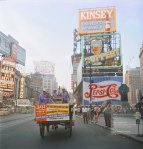
  2. Times Square, 1947
  3. Portrait Used to Design the Penny. President Lincoln Meets General McClellan – Antietam, Maryland ca September 1862
  4. Marilyn Monroe, 1957
  5. Newspaper boy Ned Parfett sells copies of the evening paper bearing news of Titanic’s sinking the night before. (April 16, 1912)
  6. Easter Eggs for Hitler, c 1944-1945 
  7. Sergeant George Camblair practicing with a gas mask in a smokescreen – Fort Belvoir, Virginia, 1942
  8. Helen Keller meeting Charlie Chaplin in 1919
  9. Painting WWII Propaganda Posters, Port Washington, New York – 8 July 1942
  10. Construction of the Golden Gate Bridge ca 1935

This is awesome.

Not something I’d typically reblog but I like.

This is bloody fantastic.

Honestly seeing old photos in color makes the past so much more tangible.

hmssmooshkin:

What she says: I’m fine
What she means: Imagine what it must have been like for people like the Duke of Wellington to live through the industrial revolution. He was almost like a living monument to the rapidly vanishing drama and romance of the previous era. He, and the rest of the nation must have known at the time of his death that the age for men like him was at it’s end and the world would never bear witness to such spectacles again now that wood transformed to iron and steel, and horses became locomotives in the short span of less than 50 years. And considering the Duke’s death shortly after the Great Exhibition of 1851, this stark dichotomy of changing times is made that much more glaring. That kind of change in so short a time has been never-before-seen and it must have been melancholy and vastly lonely and I am not fine. 

Classic ancient Maya “collapse” not caused by overpopulation and deforestation, say researchers

archaeologicalnews:

For years, archaeologist Anabel Ford has been arguing the case that the ancient Maya knew well how to manage their tropical forest environment to their advantage, eventually sustaining large populations even beyond the time when many archaeologists suggest the Maya declined and abandoned their iconic Classic period pyramidal and temple constructions and monumental inscriptions during the 8th and 9th centuries CE.  She challenges the popular theories long held by many scholars that the Maya declined because of overpopulation and deforestation from increased agricultural production, perhaps aggravated by drought and climate change.  

“In the past there was no extensive deforestation,” states Ford.

At the base of her reasoning stands years of research related to the ancient practice of the Maya in cultivating ‘forest gardens’, a method of sustainable agroforestry that employs an agricultural methodology called the Milpa Cycle—Read more.

This is particularly interesting having just recently read about failed societies.