
Can we PLEASE remove the stigma for blue collar work in America?
“You don’t wanna be a garbage collector when you grow up, do you?”
$34,000 a year, no college needed?
God forbid you take an honest job $7,000 above Michigan’s average cost of living line.
“You don’t wanna be a ditch digger.”
Bitch, I was making $15 an hour, post tax, doing exactly that, the fuck is wrong with it? (Other than it was physically exhausting.)
We need to help America, as a whole, understand that college is not, and should not be he only option, and that there is NO SHAME in trade school or even getting a career right out of high school.
I, personally, know plumbers making $80,000+ a year. Better than most 4 year degree workers.
We need plumbers, janitors, truck-drivers, garbage collectors, machinists, to keep this nation running smoothly. And they deserve respect for what they do.
Miss me with your classist bullshit.
Tag: classism
“Must have reliable transportation” = “this is how we legally discriminate against poor people who take the bus”
As someone who has held several management positions with hiring responsibility, this is true. The boss at my last job informed me before I conducted my very first I interview,
“You can’t outright ask someone if they have a car or have kids. That’s technically illegal. But you need to know because sometimes they can be deal breakers. You can just say ‘Do you have reliable transportation?’ and ‘Do you have any current circumstances that could impede you from being successful at work?’
To which the last one most people fumble and would say, “Well I have kids, so sometimes they could get sick. But that’s not often.” But then your potential employer could mark it down on your interview notes nonetheless.
I thought that maybe it was just my own employer. But now I noticed that I am asked both of these almost every time I interview for a job.
Language is very sneaky. Be careful how you answer. Corporations can be snakes.
In my businesses class my professor told us that the bus counts as reliable transportation. You do not legally have to say “I take the bus” just say “yes I do have reliable transportation” and leave it at that. Do not over share. DO NOT OVER SHARE. The second question just say no. If your kids are sick call out as if you are sick. I don’t have kids but I myself can get sick and that doesn’t hinder my ability to succeed so kids getting sick shouldn’t hinder you. When I call out I give as little info as possible. No one needs to know why you call out. They can’t ask about your “illness” because it violates HIPAA if they do. So as long as you don’t offer more info than you need to you should be okay.
I’ve never thought about it like this.
You should keep everything to yourself as much as possible including social media (which is getting harder and harder to do) the less you offer the better.
It’s really depressing how Labor Day has gone from “give laborers a day off” to “give white collar office workers and executives a day off but make retail laborers work so that executives can get a latte on their day off”
Y’all, rich people tip like shit
I pull up at this nice ass house, I’m walking to the door as the woman pulls in her driveway so the pizza is definitely not late.
I’m all smiley and courteous and shit, she tipped me $1 on a $51 bill.
The next house I have is in a lower class neighborhood, she tips me $4.00 on a $14 bill.
rich people don’t value yr labor at all
This has ALWAYS been my experience in food service. Rich people tip like shit because they feel your job isn’t a ‘real’ job. They’re used to being serviced so they don’t appreciate hard labor. It’s so gross.
And poorer people always tip nice because…well the opposite reason.
And the thing is we know servers rely on tips but so do delivery drivers. Because the US is a capitalist dystopia, there are companies that force drivers to pay for their fuel out of pocket, and I’ve known people who lost money working as delivery drivers because of this.
Also this is a more abstract form of wage loss, but they have to use their own vehicles, so the job hastens the need for oil changes, brake changes, and other expensive mechanic services.
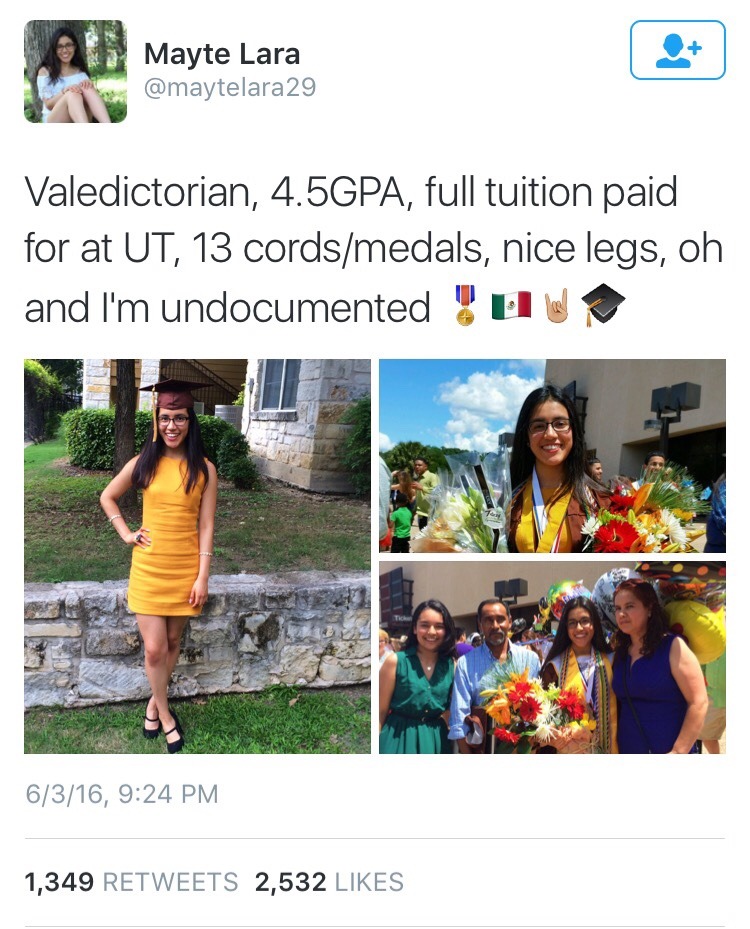
🇲🇽🇲🇽🇲🇽🇲🇽
I can’t believe how many bitchasses are crying in the notes on this post just because this girl who’s undocumented dared to excel
YAAAAS QUEEN
Criminal behavior isn’t exclusive to the uneducated. I mean how many rapists have been valedictorian?
That’s hyperbole AND a false comparison and you fucking know it.
More than likely she was brought to America as a baby and had no more choice about where she was born or grew up than any other child.
What about my comparison is false? Is she a criminal continuously engaging in criminal behaviour? Does her life status or grade level make her illegal actions legal?
What the hell is a false comparison. You can compare anything you want even if they have absolutely nothing in common it’s still a comparison. You can argue it’s not a good comparison but to call a comparison false is stupid. Whenever someone says false comparison you know they are about to bring up some special pleading argument like oh they had no choice so it’s not a crime for some reason.
And it’s not even a comparison of rapist to illegal alien I’m tired of people not understanding how analogies work. The point isn’t that rapists and illegals are the same thing or that those crimes are equitable so it’s not hyperbole either. It’s saying you wouldn’t defend one crime with the fact that the person was educated so why is that a valid defense for another crime. It isn’t.
If the point is that you can contribute and be a valued member of society then prove it and immigrate legally. And if you don’t want to be a citizen because you a proud citizen of your own country then fuck off and stay there. I hope she gets deported.
Glad she’s got full tuition while Vets have to beg for the fucking GI Bill we earned.
Honestly?
I love reading all these bitter ass pieces of shit getting their tighty whities in a bunch over this.
Any by the way, Bill, you absolute bag of used maxi pads, she EARNED that full ride scholarship with that 4.5 GPA.
Why don’t you just come out and say that you hate Mexican people instead.
Also that knee-jerk “BUT THE VETS” argument makes me want to punch a wall. These people never give a shit about how veterans are treated, never make so much as a peep about the way the US discards soldiers it rendered “unusable” until some demographic they hate makes socio-economic progress.
If y’all really gave a single fuck about vets maybe you’d volunteer to actually improve their lives, instead of just using them as props in your arguments against upward mobility. (and by the way, here are some places where you can do just that, or at least donate money to help volunteers do the work: X X X X X )
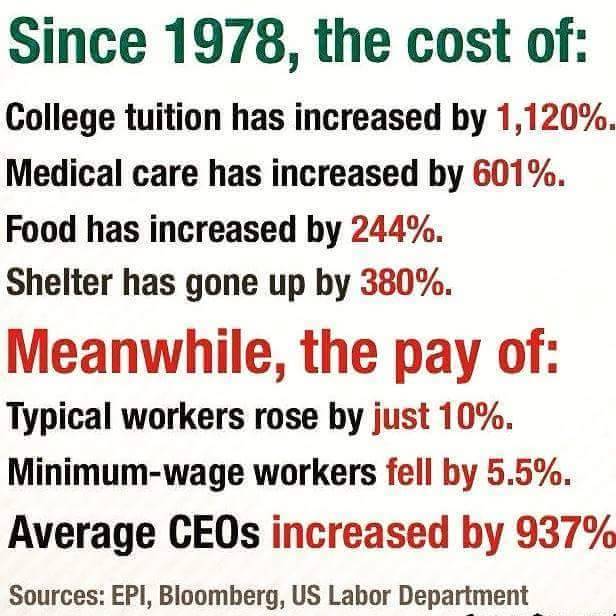
“Capitalism is oppressive because I only get 3-4 hours of free time a day”
Ok, here’s a thought, and bear with me here: increase your value on the market place so you earn more $/hr so you can choose to work less hours.
And don’t tell me you can’t do that because you can learn practically anything online for free or from library books.
A primer on poverty, free time, and choosing to earn more money.
1. The United States is second only to Nicaragua in blaming poor people for their poverty. So, congratulations you libertarian you! You’re expressing the call of the fucking herd, participating in a dumb chorus, and are not representing the light of social, practical, intellectual difference. Fully one quarter of your herd feel poor people are responsible for the own poverty in spite of the overwhelming facts pointing out the opposite. (x, y) One of the reasons for such an exaggerated fiction is that US and UK people work some of the longest and strangest hours in the world. That’s all of us, not just the poor. (x) Our fictions are bound to be more exaggerated.
2. Owners and bosses make so much more money than the average employee that the exaggeration of unearned ambition (see Adam Smith, Part I, Chapter II, here) that’s been a problem in capitalism since its inception is much more exaggerated and problematic today. It’s understandable why you want to imply poor people don’t want to work, although the opposite is the solid truth. Capitalist society values work more than equality, and so even the poorest and unhappiest people are willing to work long and strange hours. We have to address how the division of labor works to promote a sense of fairness about income inequality.
3. We use vague words like inequality to address fairness. Fact is, we can address value very specifically. Workers don’t earn anything approaching appropriate compensation for the hours they work, while owners and employers are earning much more than they’re actually worth, in spite of working similar hours. (x, y) The fact is that, for some reason, we permit some people to say they are worth more than others. Likely, this is a result of the form cooperation between employee and employer takes in capitalism, where employees sacrifice earnings for a number of promises, such as safety at work, access to forms of insurance, compensation for injury, and provided tools and resources. I know from experience that Americans believe bosses pay out of pocket for these “materials”, but the truth is labor produces them. Without labor, we’d have zero wealth creation. That’s a fact. It makes sense to complain. If we’re not going to be compensated more fairly, then we should get more time away from work.
4. I’ve addressed in another post how talking about “wealth” instead of “value” helps generate momentum for the fiction that the long hours rich employers work and the amount of wealth capitalists possess prove they’ve earned their status and wealth. It’s not true. It never has been true. Simple analysis will illustrate that. Just look at the data gathered about work. It’s easily accessible these days. On the other hand, one needs analysis plus social engineering to be able to argue wealthy people have earned their wealth while poor people haven’t earned it yet. Your hero von Mises had to compose a social theory of human action that insists it’s best to think of people as consumers and business owners rather then employee and employer for just this reason. It’s easy to talk about choices, freedom, and liberty when we’re addressing bosses and consumers and wildly wealthy elites. To be antisocialist in a capitalist society insists one must agree about a few conditions before making any arguments about social equality and identity. The theory comes not from metaphysics but from social engineering; in other words, it’s propaganda.
5. But facts are facts. In 2012, for example, the majority of able-bodied poor worked. (x) Year in and year out, the poor work. And they work hard–multiple jobs, night and day, with little sleep. Look we all know that money earned is worth more to the poor than the rich; another way to put it, poverty is expensive. Spending to sustain healthy life takes all of our money. Wealthy people can afford to spend money on investments and entertainment. They tend to lead happier lives for obvious reasons. (x) The link shows that the wealthiest people in the US receive much more of their income from wages than the poorest people do.
6. Something in the assumed rationale in your claim above tells me you think that people earn more money because they have some skills associated with their social status and pay that poorer people lack. That’s simply not the case. We know that a college degree, for example, is worth less if the student and future employee is born poor and worth more if born wealthy. (x)
We can say, without a doubt, that spending what little leisure time we have away from work “bettering” (part of the capitalist myth about social mobility is that we can choose to become better) ourselves is not necessarily going to do anything to increase our value in the workplace.
7. I’m going to give you a little wake up call for your notion that people can choose to become more wealthy. It’s certainly true in the past that much of the wealth in the US was earned rather than inherited. And this only makes sense because much of the wealth (money and value) has been only recently created via economic booms (and recoveries from busts). There wasn’t massive accumulations of wealth to bequeath in the recent past. (Caveat: for a very small, minority of Americans there always has been great wealth and that was inherited. We’re not addressing them.)
We know wealth is an accumulation of excess income over expenditures over time. Wealth inequality is on the rise, all over the world. Thus, we know that these days, and even more so in the days to come, as wealth inequality rises, more people will begin inheriting wealth rather than earning it.
Choosing to be better becomes even more of a fantastic myth.
8. Finally, it’s an intellectual cop out to claim people can educate themselves for free. I’ve been teaching for close to twenty years. Much of the education that future employees exchange for better wages involves learning achieved from within institutions that engage different learning communities and wherein people can make various valuable social connections that permit them referrals, aid, cooperation, and affiliation, all of which costs a lot of money.
Gentrifiers focus on aesthetics, not people. Because people, to them, are aesthetics.
Proponents of gentrification will vouch for its benevolence by noting it “cleaned up the neighbourhood”. This is often code for a literal white-washing. The problems that existed in the neighbourhood – poverty, lack of opportunity, struggling populations denied city services – did not go away. They were simply priced out to a new location.
That new location is often an impoverished suburb, which lacks the glamour to make it the object of future renewal efforts. There is no history to attract preservationists because there is nothing in poor suburbs viewed as worth preserving, including the futures of the people forced to live in them. This is blight without beauty, ruin without romance: payday loan stores, dollar stores, unassuming homes and unpaid bills. In the suburbs, poverty looks banal and is overlooked.
In cities, gentrifiers have the political clout – and accompanying racial privilege – to reallocate resources and repair infrastructure. The neighbourhood is “cleaned up” through the removal of its residents. Gentrifiers can then bask in “urban life” – the storied history, the selective nostalgia, the carefully sprinkled grit – while avoiding responsibility to those they displaced.
Sarah Kendzior – The peril of hipster economics (x)
 Waiting for Winter