so, there’s a lot of shit going around about banksy right now.
i’m just going to say here that i’m not a graffiti artist. i very much enjoy graffiti but i don’t make graffiti art and these are simply my personal thoughts as an outside perspective.
first of all, i don’t think that tagging and what banksy does are even in the same league. tagging is a specific statement. it takes space, it is a nonviolent way to fight the legality and oppression of the government. it breaks the law in an artistic way where nobody gets hurt. it’s used to claim territory, to immortalize, and to fight against the powers at be. in most cases, its freestyled. it takes hours. the graffiti community is tight knit and exercises a good amount of respect for one another. graffiti is seen by most as a blemish, strange words or names written fantastically on walls that don’t belong to the artist, without permission, and are often covered up by street cleaners because they depreciate business/real estate value.
i do not find banksy as a graffiti artist because he doesn’t do these things. he’s not a radical and he’s not some kind of political revolutionary. he’s not claiming space for the oppressed, he’s just trying to make a buck on a scene he probably thought was cool.
this would be fine with me, if it wasn’t for the inexcusable tragedy that was the years leading up to King Robbo’s death.
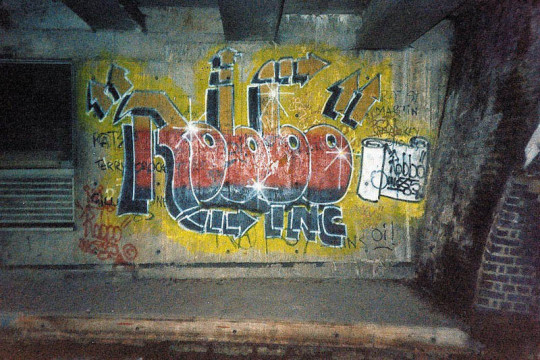
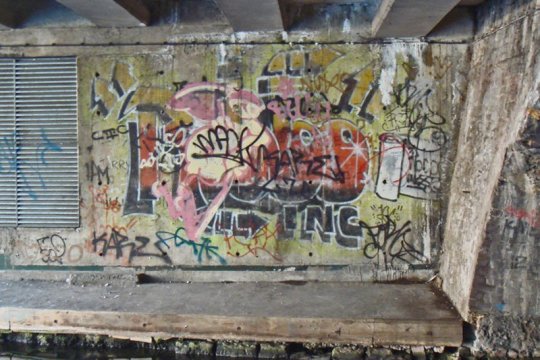
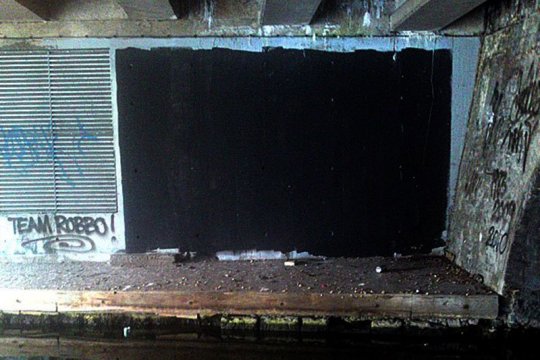
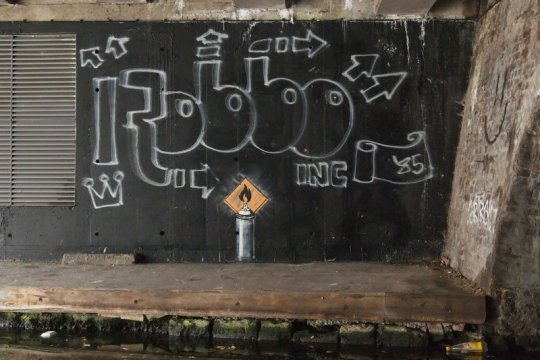
this piece was painted by King Robbo in 1985. It was located under the London Transport Police Headquarters in Camden, London. this place was only accessible by water. when most of Robbo’s other works had been covered up, this one remained. for a while it was the oldest piece in London.
by 2009, the piece had gone the way most tags go, everything is transient and every space is fair game for more people to make their marks. this is the nature of graffiti, and to it King Robbo took no offense.
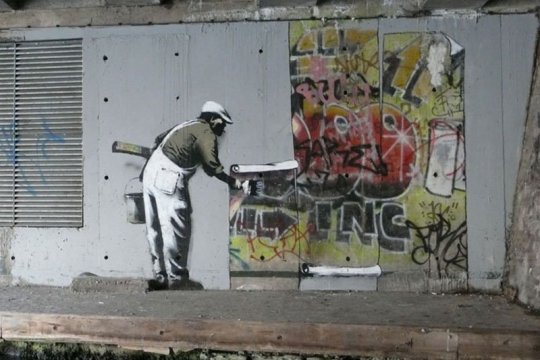
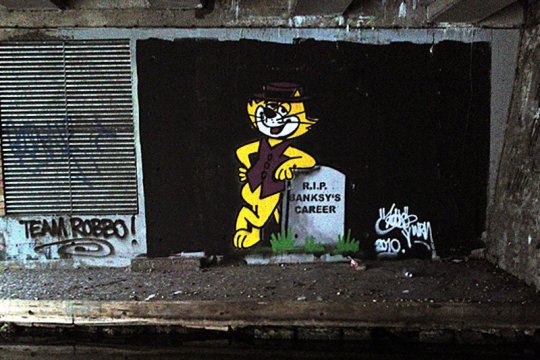
that year, Banksy painted this. It is a wall painter, removing the piece from the walls. he took the oldest piece of graffiti in london, which was no longer even just King Robbo’s, but an impromptu collaboration between many london graffiti artists, and he disrespected it. if it wasn’t enough that they were getting jailed while banksy was making millions for the same work, he disrespected them. he spit on them. he decided his statement was worth more than the oldest piece of graffiti in london and on top of that, THIS IS A STENCIL. he couldn’t even free-hand it! he decided his LITERAL cookie-cutter street art was more important that Robbo’s only surviving legacy.
insulted, King Robbo replied. he was quoted saying
“I was at a place called the Dragon Bar on Old Street. I was introduced to a couple of guys who were like ‘whoa it’s nice to meet you!’. When I was introduced to Banksy, I went ‘Oh yeah I’ve heard of you mate, how you doing?’ and he went ‘well I’ve never heard of you’…he dismissed me as a nobody, as nothing. So with that I slapped him and went ‘oh what you ain’t heard of me? you won’t forget me now will you?’ and with that he picked up his glasses and ran off.” obviously this was an insulting display to King Robbo, who had managed what most graffiti artists can never pull off, he had a timeless piece. he gained some fame, some notoriety. this piece, of all the pieces in london, banksy covered up with a stencil. EVEN SO, Robbo left banksy’s work, whereas banksy deliberately covered his up.
banksy replied. as you can see, very thought provoking. quite profound.
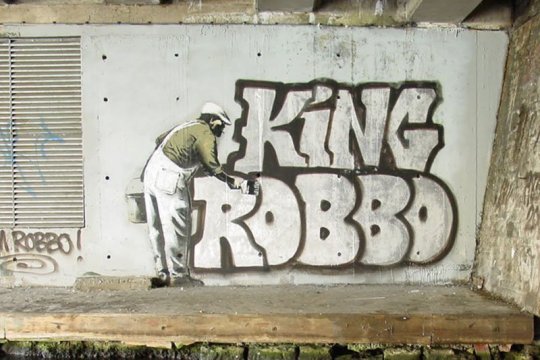
King Robbo corrected the piece.
at this point, an unknown third part covers the wall.
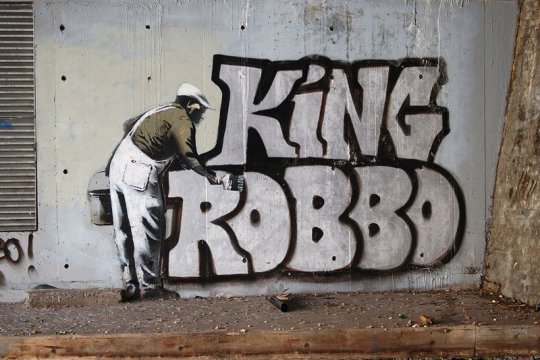
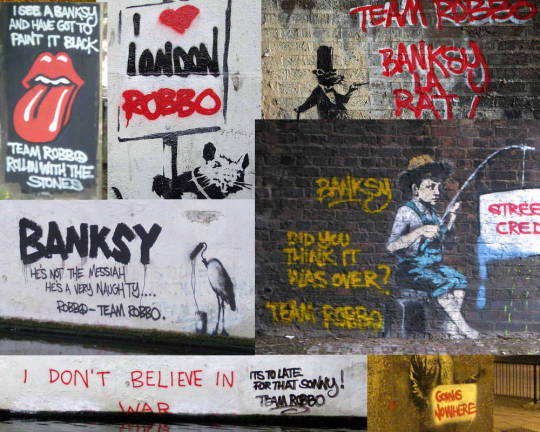
it wasn’t over, as this had become very personal for King Robbo. He painted this work. At this point, many other graffiti artists had already started tagging the streets with “TEAM ROBBO”. many of banksy’s works were being tagged over, like he did to King Robbo’s, in an effort to send a message. Mainstream media called these “defacement” and “vandalism” of banksy Originals, where the travesty against King Robbo went mostly unnoticed outside london and the graffiti community.
as you can see, Team Robbo exploded, giving many of banksy’s pieces the same respect he gave King Robbo’s long-standing artwork.
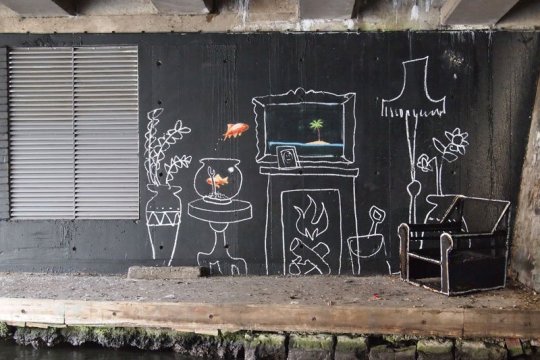
after being blacked out again, banksy painted this piece. the meaning is lost on me, if you know what it means, let me know. it’s strange and confusing.
this had gone on into 2011, when King Robbo fell into a coma. It was only 5 days before his exhibition, “Team Robbo – The Sellout Tour”. he unfortunately never got to attend his exhibition, and never again woke up. he died in july 2014.
banksy, supposedly making a memorial, made sure he got the last word:
RIP King Robbo.
So what blows my mind is when I first saw this photoset it was billed as ‘tee hee look at this good natured exchange’. Which, without context, I bought.
The fact that these two vastly different narratives exist, and the way context has been stripped from one of them to excuse Banksy, says a lot about… well, everything, including the people doing the painting. It’s one hell of a message. The way people want to sell the story (Banksy) and the way people actually fell about it (Robbo and his followers)
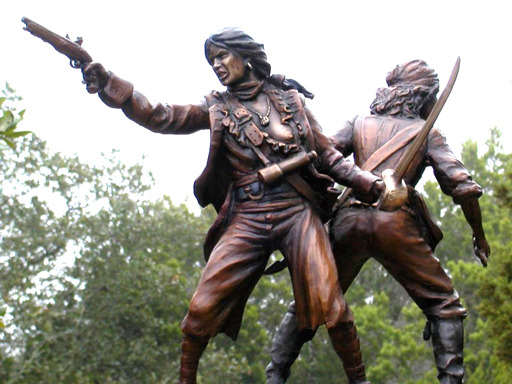
“Anne Bonny and Mary Read were pirates, as renowned for their ruthlessness as for their gender, and during their short careers challenged the sailors’ adage that a woman’s presence on shipboard invites bad luck.”
I’m not entirely sure that the statue really needed to have a tit out.
How dare women try to have nipples.
Actually I’ve seen this before and I can tell you— it’s because these women were bad ass pirates and when they killed someone they’d expose one or both breasts so that when their victim died, (s)he knew that they were killed by a woman.
ACTUALLY Anne Bonny purposely wore loose fitting clothes and displayed her breasts openly at all times during battle – mainly because men were distracted by them, and she took pleasure in killing said men while they were too busy staring at her breasts. Mary Read dressed mainly as a man (after posing as her deceased brother, Mark, for the entirety of her childhood) and both ladies cross-dressed from time to time, hopping between ships. They were known as the ‘fierce hell cats’ due to their ferocious tempers, and were key elements to Captain ‘Calico Jack’ Rackham’s crew – they were the only two known female pirates in the Golden Age of Caribbean piracy. IN FACT, when the ship was captured by the British Navy, Anne and Mary were the ONLY TWO pirates who fought while the males of the crew hid – they were all tried to be hung as pirates but Bonny and Read were both pregnant and were pardoned.
Calico Jack was a lover to Bonny, and as he was to be hung, Bonny’s final words to him were, “Had you fought like a man, you need not be hung like a dog.” Bonny and Read were possibly two of the most badass fucking pirates and they were FEMALE. The more you know.
And on top of all that, exposed breasts have a long and storied history of symbolism in art. They mean all sorts of things. The sculptor may have chosen to expose her left breast specifically to denote her courage–her heart is exposed–or to evoke comparison to Amazon warriors, who cut off their right breasts.
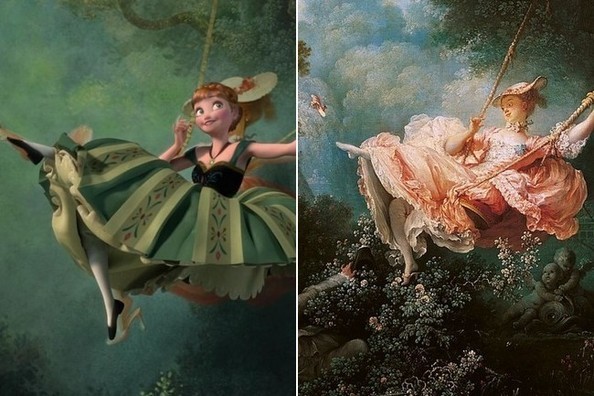
So I was going to write a post talking about Jean-Honoré Fragonard’s painting The Swing, which is, as you all know, business as usual around here. Now, the first step in any art post is finding a high-quality image, which put me on Google, which in turn led me to this.
And this is–I mean. Look, this moment slipped my mind, all right? I saw Frozen once, was deeply unimpressed, and never thought about it again. I forgot that it contained a blissfully unaware nod to a dirty painting.
Yeah. Surprise! The Swing is a dirty goddamn painting.
Duh, you say, that guy’s looking straight up her dress, but that’s mid-range dirty at best, this is eighteenth century France, the aristocracy got dirtier than that on their way to breakfast. And presumably also at breakfast. A swing isn’t good enough! More filth! Better filth, you demand, beating your hands on the table.
Well, let me just assure you that you are looking at genuinely fun dirty, and hopefully that holds you over while we take a little trip into background. Buckle in for a very French story.
Sometime in the 1760s, painter Gabriel François Doyen, fresh off the success of several large-scale religious paintings, was contacted by a “gentleman of the court”, who had seen his work and been moved by it. Pleased by the attention, Doyen went to meet this courtier, and discovered him at what he later described as “a pleasure house”, entangled an an amorous embrace with his mistress. The following exchange, related by Doyen to a writer friend of his several years after the fact, went something like this:
“Monsieur Doyen, I was so moved by your work! The angels, the colors, the piety. Its beauty is unrivaled!”
“Well, that’s–very kind of you. Although I do…that is. If you and your–ah, young lady would rather I returned later–”
“Nonsense, sit down, sit down! You should be as comfortable as we are.”
At which point Doyen, more or less trapped, did pull up a chair, although presumably not without giving it a surreptitious wipe with his handkerchief first.
The young aristocrat, whose identity is unknown, was apparently so impressed by Doyen’s religious work that he hoped to commission the artist for something decidedly less religious.
Just try to imagine it: Doyen sitting on the edge of some louche-looking parlour chair while a young man in a highly noticeable state of undress cuddles with his equally nude lady friend and describes what will surely be a masterpiece.
“I should like to see madame–” (history doesn’t tell us if he booped her nose here, but I like to imagine he did) “On a swing, being pushed by a bishop. But you will place me in such a way that I will be able to see the legs of the lovely girl, and better still, if you would like to enliven your picture a little more…”
Now you’d think, wouldn’t you, that Doyen would have gone a little pale at this and made his excuses, but hilariously, he appears to kind of get into it, all of a sudden suggesting, "Ah Monsieur, it is necessary to add to the essential idea of your picture by making Madame’s shoes fly into the air and having some cupids catch them.”
Flying shoes, he said. Essential, he said. Remember that for later.
In the end though, for whatever reason, Doyen decided not to take the commission, and passed it to Jean-Honoré Fragonard, who took the idea, looked at it, decided “too tame.”
Now, the only thing he really changed from the initial idea was the bishop. The man pushing the swing is now just a dude. A significantly older dude than the young man in the foreground, though, which is notable. We don’t know for certain why this alteration was made, maybe Fragonard didn’t want to get on the wrong side of the church. Or maybe he just sucked at drawing vestments.
The old not-bishop is hidden in shadow, holding the rope of the swing, his age and restraint rendering him unimportant. This is an image for the young and passionate. The girl on the swing leaves the trees behind, flying with her knees open towards the statue of Cupid, who holds a finger to his lips, signifying the illicit nature of this encounter. And like, make no mistake, this is an encounter. Our unnamed aristocrat lies on the ground, twined around with blossoming undergrowth, his eyes directed beneath her skirts, and his arm erect, reaching for what he sees. He holds his hat in his hand, a funny little detail until you remember that in late 18th century erotic art, men’s hats (and their bared heads) were often directly analogous with their dicks. No one ever said Rococo was subtle, okay.
The swing (and the young lady on it) are at the peak of their movement, all fluttering pinks and the soft, sinuous curve of her body beneath the glistening silk, and just as she’s gone as far as she can go, positioned over her lover’s outstretched arm, with her toes pointed at Cupid–her shoe flies off. (A missing shoe, by the way, and a bare foot, were neck-and-neck with the broken pitcher in the French Symbols Of Lost Virginity Sweepstakes.)
All of which is to say, The Swing is a painting of an orgasm.
I almost don’t know where to take it from here. Um, let’s see. Well, this became an iconic image of the Rococo period, thanks to the rich colors, freedom of movement and the finished image’s contagious joy. Mostly-contagious, anyway, Enlightenment philosophers hated it, presumably because they weren’t getting laid. But it really is hard not to smile looking at it. That girl’s having a great time.
Such a great time, in fact, that Anna from Frozen probably shouldn’t be reenacting it. Even with both her shoes on.






 Waiting for Winter