Miss Turners Magical Pet Swap Shop is a great little game in which you reshape animals for their owners changing pugs into giraffes, mice into bears and all manner of other odd requests.
The average active adult needs 2,000 calories per day in order to function in a safe and healthy manner. If I’m active to the point where I consistently run 1+ hour every day, then it is far more likely that my caloric needs are around 2,400-2,500.
Considering that, a meal of 1,200 calories would perfectly suit my needs. It would supply roughly half of my calorie requirements, which is a God-send since a fast food meal is relatively cheap. It’s a great value, especially if I don’t have much time to cook or have the resources to prepare my own meals!
The average burger is going to supply me with significant protein and carbs. That’s exactly what I’d need in order to build more muscle and have enough energy to make it through a workout. Even the sugar within the meal can be beneficial in supplying me with a boost of energy and can stop me from feeling hungry for a prolonged period of time. Not half bad.
Is this the most healthy meal known to man? Of course not. But it’s still a very reasonable deal and the calorie count is well within the average adult’s daily needs.
Don’t let calories scare you! You need them. If you were capable of burning off an entire meal within the hour, you’d probably be dead by now.
1200 empty calories in a meal
next to no nutrition. all the calories are sugar and fat. that’s it. you’ll have no energy and have glucose spikes in your blood because the lack of fiber because of the lack of complex carbs. this is diabetes in a meal.
so no, you should not be hungry for diabetes
Nutritionally, this BK meal contains roughly 28g of protein and 3g of dietary fiber. It potentiallyalso includes 35% of our Vitamin C daily requirements, 2% Vitamin A, 12% calcium, and 27% iron. Of the 1,010 calories (that I could verify directly from the company’s nutritional information guide), only 410 are from fat. That isn’t a terribly significant amount of fat, in the long run, nor are the nutrients small enough to be viewed as negligible.
Eating this will not cause you to get diabetes. Eating this meal is perfectly fine if you do have diabetes, as long as you are able to adjust your insulin intake accordingly. So don’t use an illness as your debate point – Diabetic people are not a prop.
“So don’t use an illness as your debate point – Diabetic people are not a prop.” I want that and variations of that on t shirts.
damn, man. Someone just got completely schooled by a nutritionist.
“Capitalism is oppressive because I only get 3-4 hours of free time a day”
Ok, here’s a thought, and bear with me here: increase your value on the market place so you earn more $/hr so you can choose to work less hours.
And don’t tell me you can’t do that because you can learn practically anything online for free or from library books.
A primer on poverty, free time, and choosing to earn more money.
1. The United States is second only to Nicaragua in blaming poor people for their poverty. So, congratulations you libertarian you! You’re expressing the call of the fucking herd, participating in a dumb chorus, and are not representing the light of social, practical, intellectual difference. Fully one quarter of your herd feel poor people are responsible for the own poverty in spite of the overwhelming facts pointing out the opposite. (x, y) One of the reasons for such an exaggerated fiction is that US and UK people work some of the longest and strangest hours in the world. That’s all of us, not just the poor. (x) Our fictions are bound to be more exaggerated.
2. Owners and bosses make so much more money than the average employee that the exaggeration of unearned ambition (see Adam Smith, Part I, Chapter II, here) that’s been a problem in capitalism since its inception is much more exaggerated and problematic today. It’s understandable why you want to imply poor people don’t want to work, although the opposite is the solid truth. Capitalist society values work more than equality, and so even the poorest and unhappiest people are willing to work long and strange hours. We have to address how the division of labor works to promote a sense of fairness about income inequality.
3. We use vague words like inequality to address fairness. Fact is, we can address value very specifically. Workers don’t earn anything approaching appropriate compensation for the hours they work, while owners and employers are earning much more than they’re actually worth, in spite of working similar hours. (x, y) The fact is that, for some reason, we permit some people to say they are worth more than others. Likely, this is a result of the form cooperation between employee and employer takes in capitalism, where employees sacrifice earnings for a number of promises, such as safety at work, access to forms of insurance, compensation for injury, and provided tools and resources. I know from experience that Americans believe bosses pay out of pocket for these “materials”, but the truth is labor produces them. Without labor, we’d have zero wealth creation. That’s a fact. It makes sense to complain. If we’re not going to be compensated more fairly, then we should get more time away from work.
4. I’ve addressed in another post how talking about “wealth” instead of “value” helps generate momentum for the fiction that the long hours rich employers work and the amount of wealth capitalists possess prove they’ve earned their status and wealth. It’s not true. It never has been true. Simple analysis will illustrate that. Just look at the data gathered about work. It’s easily accessible these days. On the other hand, one needs analysis plus social engineering to be able to argue wealthy people have earned their wealth while poor people haven’t earned it yet. Your hero von Mises had to compose a social theory of human action that insists it’s best to think of people as consumers and business owners rather then employee and employer for just this reason. It’s easy to talk about choices, freedom, and liberty when we’re addressing bosses and consumers and wildly wealthy elites. To be antisocialist in a capitalist society insists one must agree about a few conditions before making any arguments about social equality and identity. The theory comes not from metaphysics but from social engineering; in other words, it’s propaganda.
5. But facts are facts. In 2012, for example, the majority of able-bodied poor worked. (x) Year in and year out, the poor work. And they work hard–multiple jobs, night and day, with little sleep. Look we all know that money earned is worth more to the poor than the rich; another way to put it, poverty is expensive. Spending to sustain healthy life takes all of our money. Wealthy people can afford to spend money on investments and entertainment. They tend to lead happier lives for obvious reasons. (x) The link shows that the wealthiest people in the US receive much more of their income from wages than the poorest people do.
6. Something in the assumed rationale in your claim above tells me you think that people earn more money because they have some skills associated with their social status and pay that poorer people lack. That’s simply not the case. We know that a college degree, for example, is worth less if the student and future employee is born poor and worth more if born wealthy. (x)
We can say, without a doubt, that spending what little leisure time we have away from work “bettering” (part of the capitalist myth about social mobility is that we can choose to become better) ourselves is not necessarily going to do anything to increase our value in the workplace.
7. I’m going to give you a little wake up call for your notion that people can choose to become more wealthy. It’s certainly true in the past that much of the wealth in the US was earned rather than inherited. And this only makes sense because much of the wealth (money and value) has been only recently created via economic booms (and recoveries from busts). There wasn’t massive accumulations of wealth to bequeath in the recent past. (Caveat: for a very small, minority of Americans there always has been great wealth and that was inherited. We’re not addressing them.)
We know wealth is an accumulation of excess income over expenditures over time. Wealth inequality is on the rise, all over the world. Thus, we know that these days, and even more so in the days to come, as wealth inequality rises, more people will begin inheriting wealth rather than earning it.
Choosing to be better becomes even more of a fantastic myth.
8. Finally, it’s an intellectual cop out to claim people can educate themselves for free. I’ve been teaching for close to twenty years. Much of the education that future employees exchange for better wages involves learning achieved from within institutions that engage different learning communities and wherein people can make various valuable social connections that permit them referrals, aid, cooperation, and affiliation, all of which costs a lot of money.
Lay your arm on a flat surface and push
your thumb and pinky together. If you
don’t see a raised band across your
wrist, you are a product of evolution.
If you do, you’ve got a useless extra
muscle in your arm that is slowly being
erased from our genetic code. Source
I just did some research on this and apparently this muscle actually helps you hold a spear (something we as a majority haven’t needed to do much of in recent times, thus it is a mutation that is neither harmful nor helpful to lack this muscle) But I’ll see you all in the post-apocalyptic world with my genetic advantage to hold and throw spears~
Looks like you’re going to have to do all the spear throwing for me.
tag yourself im a spearholder
*walks up to couple*
so which of you is evolved and which is the spearholder
spearholder, both me and my SO.
XD
Is anybody… is… is anybody gonna… No? Okay. I’ll do it then.
Okay, see, this is like 94% bullshit. I mean, it’s about 6% science, yes, but it’s also 94% bullshit.
First things first, “you are a product of evolution”. What. Every organic thing on the face of the planet is a product of evolution. Evolution kicked off somewhere around 3.8 billion years ago with the first appearance of life and it hasn’t really stopped since. Everything that came before you was “a product of evolution”. That phrase doesn’t mean anything special.
But Bear, you say, it means people without the thing are just more highly evolved than those who have it!
Bullshit, I say. There is no such thing as “more highly evolved.” Evolution is not some kind of mad rat-race to see which lineage makes it to the top of Darwin Mountain first. Evolution is about creating an organism that can survive and reproduce as effectively as possible to fill a particular niche or role in its given ecosystem.
How good are you at burrowing in the dirt and eating leaf litter? You probably suck at it. But roly-polies (aka, sowbugs, pillbugs, or terrestrial isopods) are great at this! Is a roly-poly less evolved than you because it doesn’t drive a car and use the internet… or are you less evolved than a roly-poly because you can’t break down leaf litter into small, usable particles? The answer is neither–you’re both beautifully evolved organisms filling different niches in the ecosystem and doing it very well.
Now, so far as this “muscle” (it’s actually a tendon) being “slowly erased from our genetic code”… no.
Let me start out by saying something that really should have been said in the first place, because it’s a cool bit of knowledge to have and it’s fun to say: The tendon shown in the picture is called the palmaris longus. Palmaris longus! Say it out loud!
The palmaris longus is what is known as a vestigial tendon. When something is vestigial, that means that it’s no longer needed by the organism, but isn’t doing enough harm by being there that it impacts the organism’s ability to fill its niche and reproduce. A vestigial organ or body part neither helps nor hinders the organism; it’s just kinda there, a relic of eons past.
(For example, the tail of a bear. A tail is utterly useless to a bear–it is too short to provide any kind of stability while in motion, isn’t prehensile, and doesn’t play a role in body language–but they still have ‘em.)
Now, it’s true that vestigial traits have a tendency to disappear over time, but not because they’re being erased from the genetic code.
Evolution–hell, natural selection–depends on there being inherent variation among the population. If one individual has a variation that gives it an advantage, and said variation is genetically determined, there’s a slight chance their offspring will inherit that useful variation. Slight. Conversely, if one individual’s variation is a disadvantage, it may hinder its chances of reproducing, and thus prevent it from passing that unhelpful trait to the next generation.
But a vestigial trait, which confers no advantage or disadvantage, is sort of stuck in limbo and is only passed along by pure chance.
I’ve heard people say, for example, that wisdom teeth are “evolving out” of the human species, and it makes me want to throw mine–which were surgically removed when I was 18–at their faces. That’s not how evolution works. In order for a trait to “evolve out” of a species, it has to be selected against. It has to be obvious so that other members of the species can notice it and find it unsexy enough that they won’t mate with the individual displaying it.
Do you only date people who never developed wisdom teeth, in the hopes that any offspring you have with them will also never develop wisdom teeth? I’m thinking not. There’s no active selection against the wisdom tooth trait. If anything, there’s selection for the more refined, narrow jaw structure that separates our skulls from those of like every other ape on the planet (which coincidentally is why most people don’t have space in their jaws for a third set of molars to properly develop and erupt, and need their–frequently deformed–wisdom teeth extracted), and that may in turn be linked to whether or not wisdom teeth form.
Wisdom teeth, like the palmaris longus, are a vestigial trait that is being passed along purely by chance.
Oh but Bear! you say. The spear-holder argument! Our ancient cavemen ancestors who had this palmaris longus tendon could better grip and throw their spears. Wouldn’t being a better hunter make them a more desirable mate for cavewomen?
No. No it wouldn’t. And let me tell you why.
The palmaris longus is a vestigial tendon, has been for eons, and hasn’t conferred an evolutionary advantage on those who have it since we lived in trees.
Yeah. A well-developed (aka, not vestigial) palmaris longus tendon is really only found in arboreal animals, like monkeys. Found there, it does give an advantage by augmenting grip strength, and thus making those tree-dwelling monkeys a little less likely to fall out of the tree. But among humans, who are terrestrial apes? The palmaris longus is not needed and is nothing but a relic. It’s been a relic since, like, Australopithecus.
Studies show that there is no difference in grip strength between those who have the palmaris longus and those who do not. Which should surprise no one because, again, the tendon is vestigial.
Now, to make up for me crushing your hopes of being a better spear-holder, let me share with you some great facts about the palmaris longus tendon!
It’s found in roughly a quarter of the population.
It has a ridiculous amount of variety in how it presents. In some people, it’s just a tendon running from A to B along the forearm with no associated muscle. In others, the muscle (which is also poorly-developed and vestigial) is found in the middle of the tendon. In others, the muscle is at one end of the tendon. Also, in some people, it’s only present in one arm and not the other–so if you see it in one wrist, check if it’s on the other side as well. I have it on both arms.
Because it’s vestigial and is not “needed”, it is the number one choice for use in reconstructive work. Surgeons will use it to repair or replace tendons just about anywhere in the body, because they can remove it without any ill effect!
This has been your daily dose of science. Bear, out.
omg this explains it so much more and better than me
It’s called copula deletion, or zero copula. Many languages and dialects, including Ancient Greek and Russian, delete the copula (the verb to be) when the context is obvious.
So an utterance like “you a bitch” in AAVE is not an example of a misused you, but an example of a sentence that deletes the copular verb (are), which is a perfectly valid thing to do in that dialect, just as deleting an /r/ after a vowel is a perfectly valid thing to do in an upper-class British dialect.
What’s more, it’s been shown that copula deletion occurs in AAVE exactly in those contexts where copula contraction occurs in so-called “Standard American English.” That is, the basic sentence “You are great” can become “You’re great” in SAE and “You great” in AAVE, but “I know who you are” cannot become “I know who you’re” in SAE, and according to reports, neither can you get “I know who you” in AAVE.
In other words, AAVE is a set of grammatical rules just as complex and systematic as SAE, and the widespread belief that it is not is nothing more than yet another manifestation of deeply internalized racism.
This is the most intellectual drag I’ve ever read.
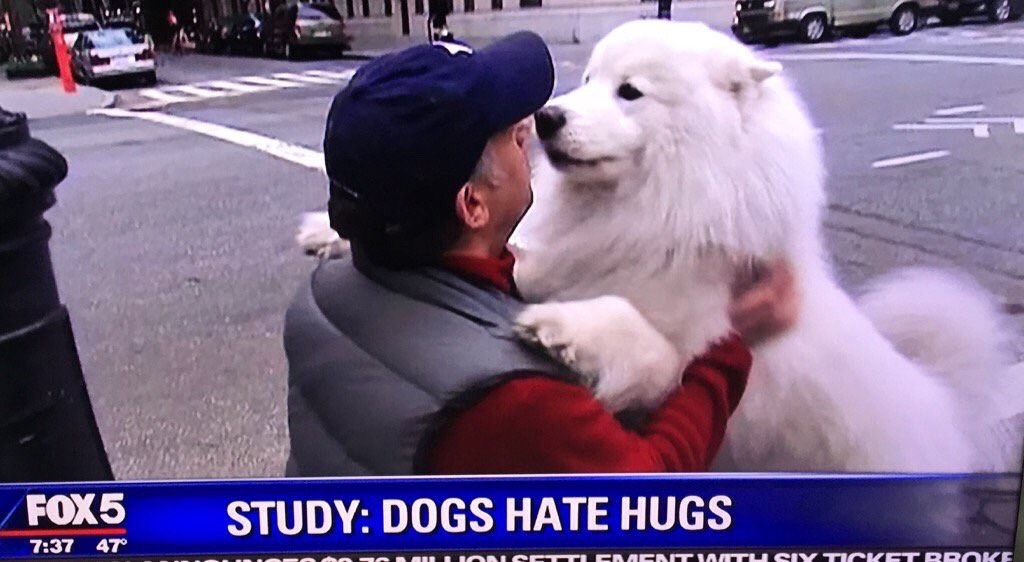
As a dog trainer, I can tell you that probably 50% of dogs really don’t like hugs and at least another 48% pretty much just tolerate them. Very few dogs I know genuinely like hugs the way humans tend to give them. What’s funny is that the picture that Fox used with this headline is one of the more common ways dogs do enjoy contact that humans would consider a hug.
Stanley Coren – the dude who wrote the article that is pissing everyone off about this – really does know what he’s talking about. He wrote one o my favorite books, called how to speak dog, which has some absolutely beautiful diagrams of dog behavior and body language along the gamut of extreme situations.
The way humans hug dogs is often really uncomfortable for them. We lean over them and trap them (think how many dogs we already know are spooky when you loom over them, but are fine if you get down to their level), and then we restrict their ability to move and shove our faces close to theirs. That’s not fun. Keep in mind that most dogs have personal space bubbles that are larger than we tend to think, and now you’re not only invading it, you’re making it so they can’t move or defend themselves if something happens.
Look at this photo from a couple years ago. Avalanche is probably the most tolerant dog I know of things that press his physical boundaries – he lets little kids do things to him that make me cringe and doesn’t even seem to notice half the time. This was right before I had to head back to college and I knew I wouldn’t see him for another 6 months, so I hugged him because sappy human emotions. I have an amazing relationship with this dog, and look at his body language. He’s kinda stiff, his face is a little tense, and the corners of his mouth are pulled back a little. All in all, he’s supremely un-enthused but he’s letting me do it. After about five seconds, he huffed out the sigh he uses to let me know when he’s done with the hug, and then pulled back and shook off.
Most dogs learn to tolerate hugs because we do it to them so often. It’s pretty much a kind of learned helplessness, plus, they like us and so they put up with our stupid human behavior. When you hug most dogs, you’ll notice they get kinda stiff, they look away or at other humans for help, you’ll see side-eyes or look-aways (not whale eye). Often they’ll distract you by doing something else like pawing at you, or licking your face as an appeasement signal. They’re all signs of discomfort that we already routinely ignore when we deal with our dogs, so it makes sense that people think their dogs are fine with it – they’re just still not listening.
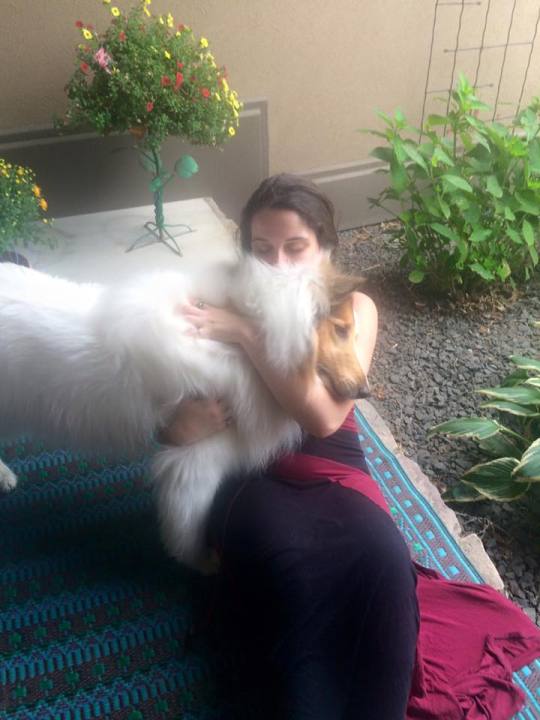
More often, you’ll get dogs that will crawl up your chest when you sit and put their paws on your shoulders. Sometimes their face is close to yours, sometimes it’s on your shoulder. In that position – which they often initiate – they ca easily withdraw and get away if necessary and they’re not trapped or being leaned over. It’s not really a hug, just close contact, but I think it’s about as close as humans are going to get to one that a dog will enjoy.
Once slavery was abolished in 1865, manufacturers scrambled to find other sources of cheap labor—and because the 13th amendment banned slavery (except as punishment for crimes), they didn’t have to look too far. Prisons and big businesses have now been exploiting this loophole in the 13th amendment for over a century.
“Insourcing,” as prison labor is often called, is an even cheaper alternative to outsourcing. Instead of sending labor over to China or Bangladesh, manufacturers have chosen to forcibly employ the 2.4 million incarcerated people in the United States. Chances are high that if a product you’re holding says it is “American Made,” it was made in an American prison.
On average, prisoners work 8 hours a day, but they have no union representation and make between .23 and $1.15 per hour, over 6 times less than federal minimum wage. These low wages combined with increasing communication and commissary costs mean that inmates are often released from correctional facilities with more debt than they had on their arrival. Meanwhile, big businesses receive tax credits for employing these inmates in excess of millions of dollars a year.
While almost every business in America uses some form of prison labor to produce their goods, here are just a few of the companies who are helping prisoners pay off their debt to society, so to speak.
Whole Foods. The costly organic supermarket often nicknamed “Whole Paycheck” purchases artisan cheese and fish prepared by inmates who work for private companies. The inmates are paid .74 cents a day to raise tilapia that is subsequently sold for $11.99 a pound at the fashionable grocery store.
McDonald’s. The world’s most successful fast food franchise purchases a plethora of goods manufactured in prisons, including plastic cutlery, containers, and uniforms. The inmates who sew McDonald’s uniforms make even less money by the hour than the people who wear them.
Wal-Mart. Although their company policy clearly states that “forced or prison labor will not be tolerated by Wal-Mart”, basically every item in their store has been supplied by third-party prison labor factories. Wal-Mart purchases its produce from prison farms where laborers are often subjected to long, arduous hours in the blazing heat without adequate sunscreen, water, or food.
Victoria’s Secret. Female inmates in South Carolina sew undergarments and casual-wear for the pricey lingerie company. In the late 1990’s, 2 prisoners were placed in solitary confinement for telling journalists that they were hired to replace “Made in Honduras” garment tags with “Made in U.S.A.” tags. Victoria’s Secret has declined to comment.
Aramark. This company, which also provides food to colleges, public schools and hospitals, has a monopoly on foodservice in about 600 prisons in the U.S. Despite this, Aramark has a history of poor foodservice, including a massive food shortage thatcaused a prison riot in Kentucky in 2009.
AT&T. In 1993, the massive phone company laid off thousands of telephone operators—all union members—in order to increase their profits. Even though AT&T’s company policy regarding prison labor reads eerily like Wal-Mart’s, they have consistently used inmates to work in their call centers since ’93, barely paying them $2 a day.
BP. When BP spilled 4.2 million barrels of oil into the Gulf coast, the company sent a workforce of almost exclusively African-American inmates to clean up the toxic spill while community members, many of whom were out-of-work fisherman, struggled to make ends meet. BP’s decision to use prisoners instead of hiring displaced workers outraged the Gulf community, but the oil company did nothing to reconcile the situation.






















 Waiting for Winter